
Singlish in PSLE Oral: Impact on Scores
PSLE Oral, Singlish, Singapore Parents
Singlish in PSLE Oral: What’s Acceptable and What Costs Marks
By Hakim Harsono, Speak Easy — a clear, honest guide for Singapore parents who worry that Singlish will pull down PSLE oral scores.
1. The Singlish Question Parents Keep Asking
In almost every Singapore parent chat about PSLE oral, one question appears: “If my child uses Singlish, will they die already?” The fear is real, especially for families where home language is mostly Singlish. You might feel guilty, like you should have enforced “proper English” from nursery.
The honest answer is nuanced. Singlish itself is not evil, and examiners are not out to punish children for sounding Singaporean. But certain Singlish grammar and vocabulary can cost marks if they appear repeatedly. Understanding this line clearly is the first step to helping your child, without shaming how your family naturally speaks at home.
2. What PSLE Examiners Are Actually Listening For
PSLE oral is marked against Standard Singapore English, not “Queen’s English” or some BBC reporter accent. A Singapore accent is perfectly fine. Your child does not need to sound like they grew up in London or New York to score well in PSLE oral Standard English Singapore assessments.
Examiners focus on:
- Clarity — Can they be easily understood?
- Accuracy — Is the grammar mostly standard and consistent?
- Range — Do they use appropriate vocabulary and full sentences?
What they do not penalise is simply sounding Singaporean. The issue is not accent; it is non-standard structures that make the speech less accurate or less formal than expected for an exam setting.
3. Singlish Features That Can Cost Marks
Here are common Singlish constructions that, if used repeatedly, can lower your child’s oral band:
- “Already” as an aspect marker — “I finished already” instead of “I have finished” or “I finished it just now.”
- Sentence-final particles — “lah”, “leh”, “lor”, “mah” (e.g. “Very crowded lah”) that make the tone informal and non-standard.
- Missing articles — “I went to library” instead of “I went to the library.”
- “Can” as a standalone response — Examiner: “Would you like to try this?” Child: “Can.” Better: “Yes, I can” or “Yes, I would like to try.”
- Inverted tense — “Yesterday I go there” instead of “Yesterday I went there.”
- Double subjects — “My father, he likes to cook” instead of “My father likes to cook.”
One or two slips are human. But if these patterns appear throughout the conversation, examiners will reasonably judge that the child is not consistently using Standard English, and marks will drop. This is how Singlish affect PSLE marks in a concrete way.
4. What Does Not Get Penalised
Just as important is what examiners are not looking to punish:
- A normal Singapore accent — Our local rhythm and intonation are fine as long as words are clear.
- Occasional mispronunciations — If your child stumbles over one or two harder words, it is not the end of the world. Consistent mispronunciation patterns are more of a concern than one-off mistakes.
- Nervous slips — A bit of “uh” or a tense grammar mistake when they are anxious is normal. Examiners know these are 12-year-olds in a high-stakes setting.
Your child does not need to be perfect; they just need to be mostly standard, mostly clear, most of the time.
5. The Honest Truth About Singlish at Home
For many families, Singlish is the language of love, jokes, and everyday life. Expecting a Primary 6 child to suddenly “switch off” Singlish in a stressful exam, just because we told them to, is unrealistic and unfair. Code-switching is a skill, not a moral decision.
The goal is not to suppress Singlish completely. Instead, help your child build a separate “oral mode” register — a Standard English setting that automatically turns on for school, exams, and formal situations. Like any habit, this “switch” only develops with repeated practice in safe, low-pressure conditions.
6. A Simple Weekly Practice That Works
Here is a practical way to build that oral mode without scolding or nagging:
- Pick one PSLE-style oral question — for example, a picture-based prompt or opinion question.
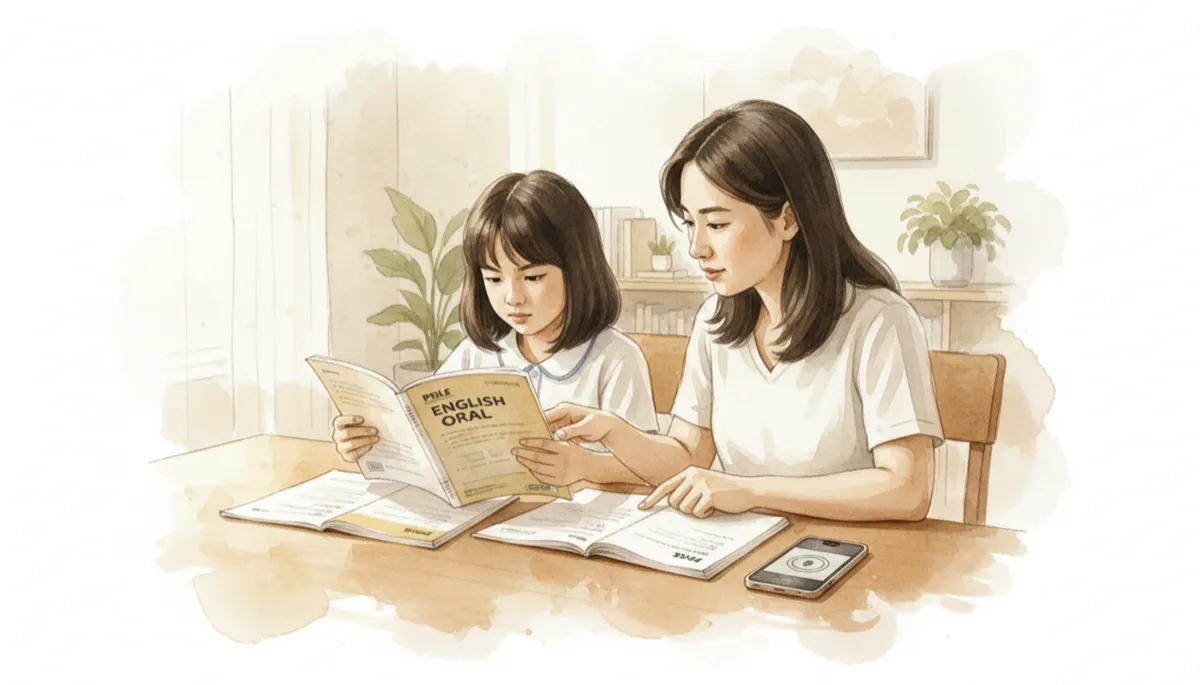
- Ask your child to answer naturally, in Singlish, and record it on your phone.
- Then ask them to answer again, this time in their best Standard English, and record that too.
- Play both versions back. Let them notice the differences in grammar, vocabulary, and tone. Gently highlight problem areas like “already”, missing articles, or “can” answers.
The gap they hear is the gap to close. Do this once a week. Over time, you will hear the Standard English version becoming more natural and the Singlish features reducing automatically in exam-style responses.
7. Next Steps: Get Structured Support
If you want clearer guidance, sample questions, and proven routines to improve Singlish PSLE oral Singapore performance without shaming your child’s home language, I have put together resources specifically for Singapore families like yours.
Visit hakimharsono.com/start to learn how Speak Easy helps P6 students build a confident, exam-ready Standard English oral mode — while still respecting the Singlish that makes home feel like home.
