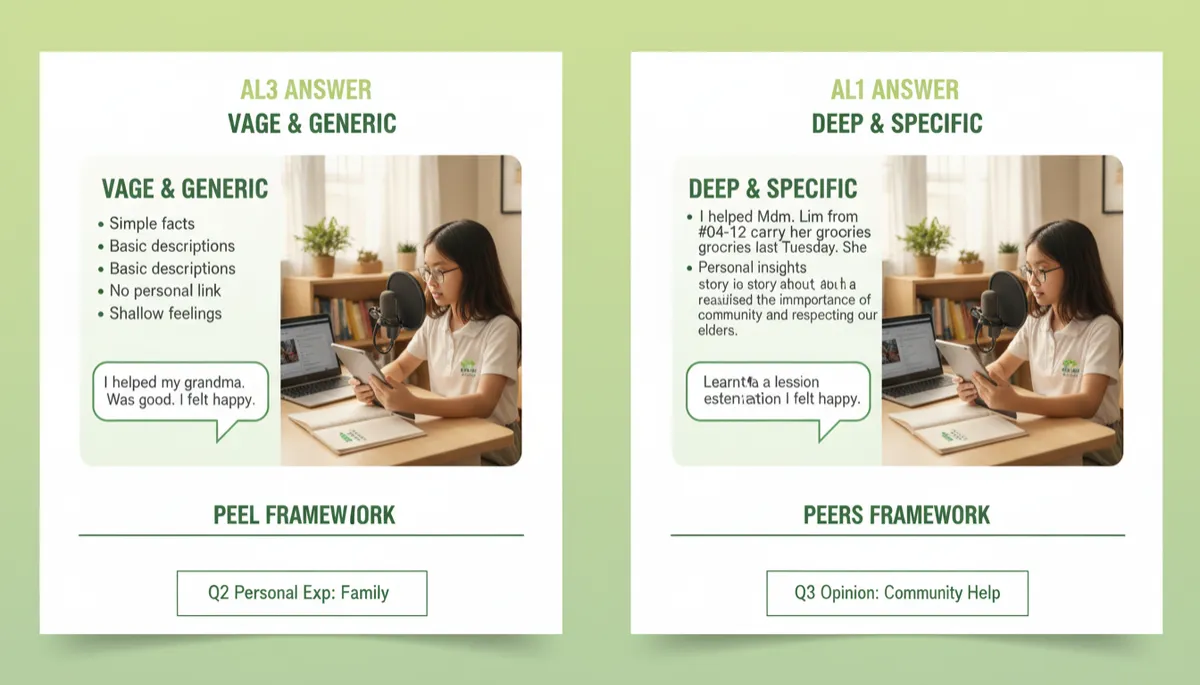
Score AL1 in PSLE English Oral: Complete Guide
PSLE English, Oral Exam, AL1 Strategies
How to Score AL1 in PSLE English Oral: The Complete Framework Guide
A practical, step-by-step system for P6 students and parents who want clear, repeatable strategies to turn PSLE English Oral from guesswork into a structured path to AL1.

1. Introduction: What Really Separates AL1 from AL2 and AL3
When parents ask how to score AL1 PSLE oral, they usually say, “My child needs more bombastic words.” In reality, examiners are not giving AL1 for fancy vocabulary. They are rewarding content specificity — clear details, personal insight and reflective extension — delivered in clear, standard English. Depth, not decoration, earns top marks.
Think of the oral exam as the examiner asking, “Do you really understand this situation, and can you think about it in a mature way?” An AL3 student often:
- gives short, generic answers (“Family is important because they support us.”)
- uses memorised phrases that don’t fit the question well
- focuses on sounding “chim” instead of being clear and honest
An AL1 student, on the other hand, does three things consistently:
- gives specific details (names, places, small actions, real examples)
- shares personal feelings and thoughts, not textbook answers
- adds a reflective extension — what they learnt or would do differently next time
This guide will walk you through a complete, practical framework system used at Speak Easy PSLE Oral Specialist: PACT for Reading Aloud, PEEL for Q2 Personal Experience, PEERS for Q3 Opinion, and 5W1H for Q1 Photo Analysis. We will also cover how to avoid common Singlish traps and how to use reflective extension to push answers into AL1 territory. Work through each section slowly, and practise with your child — you will see a clear difference in just a few sessions.
2. PACT Framework for Reading Aloud: Decoding the Preamble
Before Reading Aloud, the examiner will read a short preamble, for example:
“This passage is from a school newsletter. It is about a Primary 6 pupil who volunteered at a community centre during the holidays. Read the passage aloud as if you are sharing this story with your classmates.”
Many students ignore this and just read. AL1 students use PACT to shape how they read:
- P – Purpose: Why is this text being read? Is it to inform, persuade, entertain or describe? Purpose tells you how serious or light-hearted to sound.
- A – Audience: Who are you reading to? Classmates, parents, the public? You speak differently to your friends compared to a principal’s speech.
- C – Context: What is the setting or occasion? A school assembly, a newsletter, a radio show? Context affects formality and energy level.
- T – Tone: What emotional register fits? Warm, excited, serious, reflective, worried? Tone is the “flavour” of your voice.
Worked Example Using PACT
Using the sample preamble above:
- Purpose: To inform and inspire others about volunteering. So you should sound encouraging and positive, not flat or bored.
- Audience: Your classmates. You can sound friendly and natural, not like a robot reading the news.
- Context: A school newsletter. Semi-formal, but still warm and relatable. Imagine your form teacher reading a story to the class.
- Tone:Cheerful and reflective. Smile slightly when you read; soften your voice when the passage mentions feelings or lessons learnt.
3. Reading Aloud Technique: Expression, Pacing, Fluency and the 3-Register Practice
Once you understand PACT, you need solid technique. Examiners look at three main things: expression, pacing and fluency. Here is how to train each one in a practical way at home.
Expression: Match Emotion to Text
Expression is not acting dramatically. It is about slight changes in pitch and volume to match meaning. If the character is excited, your voice should rise slightly. If the passage becomes serious, slow down and lower your pitch a little. Underline feeling words (for example, “nervous”, “thrilled”, “relieved”) during practice and decide how your voice will change at those points.
Pacing: Control Speed and Pauses
Many P6 students rush because they are nervous. A simple rule:
- Comma (,): half-beat pause — a quick breath or tiny stop.
- Full stop (.) / Question mark (?) / Exclamation (!): one full beat pause — count “one” in your head before continuing.
Slow down slightly before important words (for example, “finally”, “however”, “unfortunately”) and stress them by saying them a little louder or longer.
Fluency and the 3-Register Practice Method
Fluency means smooth reading with minimal hesitations or self-corrections. To build this, use the 3-register practice method for any passage:
- Register 1 – Read it flat: Read slowly, focusing only on accurate words and punctuation. No need for expression yet. This is your “safety check”.
- Register 2 – Read with emotion: Now add expression and pacing. Imagine you are telling the story to a younger sibling or friend. Keep it natural, not exaggerated.
- Register 3 – Record and listen back: Use a phone to record yourself. Listen and ask: “Did I sound rushed? Did I pause at punctuation? Did my tone match the story?” Identify one thing to improve and record again.
4. PEEL Framework for Q2 Personal Experience: From Vague to Specific
Q2 usually asks you to share a personal experience related to the theme. To move from AL3 to AL1, use the PEEL framework:
- P – Point: Answer the question directly in one clear sentence.
- E – Example: Give a specific real example with names, places and small details (for example, “last June holidays at East Coast Park with my cousin Aisyah”).
- E – Elaborate: Describe your feelings and what happened in a bit more detail. Bring the marker into the scene with you.
- L – Link: Tie your story back to the question or theme in one sentence.
AL3 vs AL1 Example (Theme: Family)
Question: “Tell me about a time when you felt especially close to your family.”
| AL3 Answer (Vague) | AL1 Answer (Specific with PEEL) |
|---|---|
| I felt close to my family when we had dinner together. We always eat together and talk about our day. I feel happy because my parents care about me and support me in my studies. Family is important because they are always there for us. | Point: I felt especially close to my family during my birthday last year. Example: It was on 15 October last year, a Friday night, and I had just come home from supplementary lessons. When I opened the door of our flat in Tampines, my parents and my younger sister, Hana, suddenly shouted, “Happy birthday!” There was a small chocolate cake on the dining table with my name written in blue icing. Elaborate: I was surprised because I knew money was tight that month and I had told my mother not to buy anything big. She smiled and said, “We saved a little every week for this.” I remember feeling a warm, heavy feeling in my chest and my eyes became teary. Even though the celebration was simple, we spent the whole evening laughing, taking silly photos and talking about our favourite memories from when I was younger. Link: That night made me realise that being close to my family does not depend on expensive presents, but on the effort and love they show in small, thoughtful ways. |

Clear frameworks help students see exactly how AL1 answers differ from vague AL3 responses.
5. PEERS Framework for Q3 Opinion: Building Mature, Reflective Views
Q3 asks for your opinion on a broader issue, often linked to community or values. To stand out, you need to go beyond “I agree because it is important.” Use the PEERS framework:
- P – Point: State your opinion clearly in one sentence.
- E – Explain: Give one or two reasons why you think so.
- E – Experience: Add a real personal example that supports your view.
- R – Reflect: Share what you learnt or how your thinking changed.
- S – Summarise: Restate your position with a bit of nuance, not just repeating your first sentence.
AL3 vs AL1 Example (Theme: Helping Neighbours/Elderly)
Question: “Do you think it is important for young people to help their neighbours, especially the elderly?”
| AL3 Answer (Generic) | AL1 Answer (PEERS) |
|---|---|
| Yes, I think it is important for young people to help their neighbours, especially the elderly. This is because they are old and cannot do many things. We should help them carry things or give up our seats. If we help them, our community will be more caring and harmonious. Therefore, I think we should help whenever we can. | Point: Yes, I strongly believe young people should make an effort to help their neighbours, especially the elderly. Explain: Many elderly people live alone and may struggle with simple tasks like carrying groceries or using their phones. When young people step in to help, it not only makes daily life easier for them, but also makes the neighbourhood feel safer and more connected. Experience: For example, my neighbour, Uncle Lim, is in his seventies and lives by himself in the flat next to mine. During the last Chinese New Year, I noticed him trying to carry two heavy bags of mandarin oranges up the stairs because the lift was under maintenance. I quickly offered to help him carry the bags up to the fifth floor. He thanked me and later, a few days after, he gave my family a small box of pineapple tarts to show his appreciation. Reflect: That incident made me realise that a small action, which took me only a few minutes, meant a lot to him. It also reminded me that one day, my own grandparents might need help from others too. Summarise: So, I feel that when young people help their elderly neighbours, we are not just doing a good deed for that day. We are building a caring community where people look out for one another, regardless of age. |
6. 5W1H Method for Q1 Photo Analysis: Describe, Infer, Interpret
For Q1, many students only describe what they see: “The boy is running. The girl is smiling.” That is not enough for AL1. Examiners want you to notice details and infer meaning. Use the 5W1H method to guide your answer:
- Who: Who is in the picture? Notice age, relationship, expressions and body language. Are they classmates, family members, strangers?
- What: What are they doing? What objects are they using? Mention at least two or three key actions or items.
- Where: Where is this taking place? School canteen, library, park, MRT station? Use clues like signs, furniture or clothing.
- When: When might this be happening? Time of day, school term, special occasion? Look at lighting, decorations or uniforms.
- Why: Why might they be doing this? This is where you infer. For example, “The boy is helping the uncle pick up fallen groceries, probably because the uncle dropped them accidentally and the boy wants to be kind.”
- How: How do they feel? How is the mood or atmosphere? Use expressions and body language to guess feelings like nervousness, excitement or frustration.
An AL1-style description does not just say, “The girl is smiling.” It might say, “The girl in the school uniform is smiling broadly and leaning forward to high-five her friend, which suggests she is feeling proud and excited, possibly because they just finished a group project successfully.”
7. How to Avoid Singlish Traps in PSLE Oral
Examiners understand that we live in Singapore and that students naturally use Singlish with friends. However, during the oral exam, marks are given for Standard English. Certain Singlish habits can pull your score down, even if your content is strong. Here are common traps to avoid, with practical fixes.
Common Singlish Mistakes
- Dropping “is/are”: “The boy running” → should be “The boy is running.”
- Using “very the”: “The queue is very the long.” → should be “The queue is very long.”
- “Can or not?” → should be “Is that okay?” or “Is it possible?”
- Overusing filler words: “erm”, “like”, “actually”, “basically”, “you know”.
Practical Practice Routine to Fix Singlish
You do not need to sound like a newsreader. You just need clear, standard sentences. Here is a simple routine:
- Daily 5-sentence practice: Choose any topic (for example, “My recess today”) and say five full sentences in Standard English. Parents can listen and gently correct missing “is/are”, wrong tenses or Singlish phrases.
- Record and self-correct: Once or twice a week, record a Q2 or Q3 answer. Play it back and write down one or two Singlish phrases you used. Rewrite them in Standard English, then record again using the improved version.
- Filler word challenge: Ask a family member to raise a finger each time you say “erm”, “like” or “actually” while you answer. Your goal is to reduce the number of fingers over time. This makes you more aware of your speech habits.
8. The Reflective Extension Step: Where AL1 Marks Are Won
The biggest difference between AL1 and AL2 answers is often the last 1–2 sentences. Many students stop after telling the story or giving their opinion. AL1 students add a reflective extension — they show that they have thought about the experience and learnt something from it. This signals maturity to the examiner.
After any Q2 or Q3 answer, ask yourself:
- What did this experience teach me?
- How did it change the way I think or behave?
- What would I do differently next time?
Then, add one sentence to show that reflection. Here are some example reflective extension phrases you can memorise and adapt:
- “Looking back, this experience taught me that ________, and I now try to ________ whenever I am in a similar situation.”
- “Because of this incident, I realised that I should not take ________ for granted, so nowadays I make an effort to ________.”
- “If I had the chance to go through this again, I would ________, because I now understand that ________.”
For example, in the earlier family birthday story, a reflective extension could be: “Because of that simple celebration, I realised that my parents quietly sacrifice for me in ways I do not always notice, so nowadays I try to show my appreciation by helping with housework without being asked.”
9. Call to Action: Turn These Frameworks into a Habit
Frameworks like PACT, PEEL, PEERS and 5W1H give your child a clear roadmap for the PSLE English Oral exam. But like any skill, they only become natural when practised consistently in a supportive environment. Many P6 students know what to do in theory, but during the actual exam, nerves take over and they fall back into vague, rushed answers or Singlish habits.
At Speak Easy PSLE Oral Specialist, we focus on turning these frameworks into automatic habits through guided practice, targeted feedback and realistic mock exams. If you would like your child to experience how a structured, framework-based approach can lift their oral performance, you are warmly invited to book a trial session.
Visit hakimharsono.com/start to schedule a trial. In that session, your child will:
- try the PACT, PEEL, PEERS and 5W1H frameworks with real exam-style tasks
- receive specific feedback on content depth, Singlish traps and reflective extension
- leave with a clear, personalised action plan to move closer to AL1 for PSLE English Oral
Whether your child is currently at AL3 or already near AL2, a practical, framework-focused approach can make the difference in those crucial final months. Start early, practise consistently, and let the frameworks do the heavy lifting — so your child can walk into the PSLE Oral room confident, prepared and ready to show true AL1 thinking.
