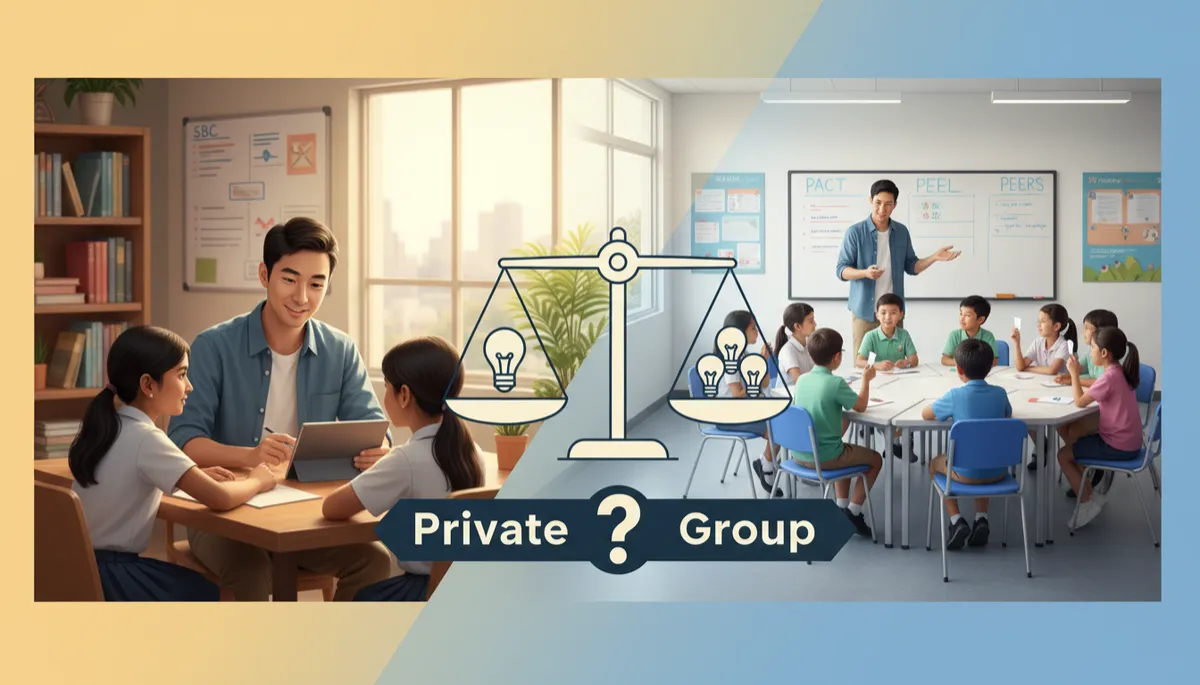
PSLE Oral Tuition: Private vs Group Guide 2027
PSLE Oral Tuition Singapore, Private PSLE Oral Tuition, Group PSLE Oral Tuition
PSLE Oral Tuition Singapore: Private vs Group — The Complete 2027 Guide
By Hakim Harsono, Singapore’s only PSLE Oral Specialist (Speak Easy, A for Oral Masterclass). If you’re a parent deciding between private and group PSLE oral tuition in Singapore for 2027, this guide gives you clear answers, real market rates, and a step-by-step way to choose what is best for your child — not just what is cheapest or most convenient.

Why Specialist Oral Tuition Beats General English Tuition for PSLE Oral
From 2025 onwards, the PSLE English Oral exam is worth 40 marks — a full 20% of your child’s English grade under the new format confirmed to continue in 2027. Yet in most general English tuition classes, oral is treated as a side dish, not the main course. That mismatch is the single biggest reason many otherwise strong students still score 28/40, 30/40, instead of 36–40/40.
In a typical 90‑minute group English tuition session, you might see:
- 45–60 minutes on comprehension, grammar, or composition worksheets
- 10–20 minutes of teacher explanation and model answers
- 5–10 minutes where your child actually speaks
For a skill that is live performance under pressure, 5–10 minutes of speaking per week is simply not enough. Oral is not a worksheet skill. It is a muscle. Muscles grow with repetition, feedback, and correction — not by watching others speak or filling in blanks on paper. This is where specialist PSLE oral tuition Singapore programmes are fundamentally different from general English tuition.
In a specialist setting, every minute is oral. There are no comprehension passages to “fill time.” Instead, lessons are centred on:
- Reading Aloud with PACT — Purpose, Audience, Context, Tone, aligned with the 2025–2027 format where a “given situation” guides how your child should sound.
- Stimulus‑Based Conversation (SBC) — using real photographs, no text, and three independent questions, exactly like the current exam, where there are no sub‑prompts to rescue your child if they freeze.
Specialist oral tuition focuses on live practice + specific feedback: pronunciation, pacing, expression, content structure, and genuine opinions. A specialist does not say “just talk more” or “memorise this script.” Instead, they give a named, teachable framework your child can apply to any picture or question. That is how students reach 37–40/40 consistently, even when the topic is completely new on exam day.
How Much Does PSLE Oral Tuition Cost in Singapore?
Before you choose between private and group, you need a clear picture of PSLE oral tuition cost Singapore in 2027. Based on 2025–2026 market data from platforms like Eduprime, PSLEPrep, and TutorMeet, and projected forward, here is what parents can realistically expect to pay:
- Budget group classes (8–12 students): about $80–$150 per month — usually general English with some oral, not specialist programmes.
- Mid‑range group (5–8 students): around $150–$280 per month, sometimes with more oral practice but still often worksheet‑heavy.
- Private hourly tuition: typically $60–$120 per hour for 1‑to‑1 English or oral‑focused sessions, depending on tutor experience and credentials.
- Specialist oral programmes (full‑course pricing): structured courses instead of pay‑per‑hour: Group Masterclass at about $1,000 and Private 1‑on‑1 at about $2,000.
The big difference is hourly billing vs programme pricing. With typical private tuition, you pay, for example, $80 per hour, one hour a week, for as many weeks as you choose. There is no clear end‑point, and progress depends heavily on how structured the tutor is and how long you keep going. It can quietly add up to $1,000+ over a few months without a defined curriculum or outcome.
In contrast, a specialist programme with full‑course pricing is designed as a complete system. You are not just buying hours; you are buying:
- A fixed, proven framework (for example, PACT + PEEL + PEERS) that your child can rely on in the exam.
- A clear timeline — you know when the course starts, ends, and what will be covered each step of the way.
- Built‑in exam simulation, targeted drilling, and parent feedback — not “see how it goes” week by week.
If you are comparing PSLE oral tuition Singapore options fairly, look beyond the hourly rate. Ask: “At the end of this amount spent, will my child have a repeatable system for both Reading Aloud and SBC, or just a pile of worksheets and vague encouragement?”
Private 1‑on‑1 Coaching ($2,000) — What Is Included?
For parents considering private PSLE oral tuition, here is what Hakim Harsono’s 1‑on‑1 programme (about $2,000 for the full course) actually includes — and why it works especially well for students who need fast, targeted improvement before 2027 PSLE Oral.
- Every minute dedicated to one student. There is no waiting while others speak, no “pair work” where your child copies a stronger classmate. The full session is your child speaking, refining, and trying again.
- 40–50 minutes of active speaking per hour. In most sessions, your child is talking for the majority of the time — reading, answering SBC questions, and attempting follow‑up questions under exam‑style timing. This is several weeks worth of speaking time compressed into a single lesson, compared to typical group tuition.
- Personalised targeting of specific weaknesses. Some children freeze when the examiner looks at them. Others read in a flat, robotic tone. Some give extremely short answers. Others slip into Singlish or informal phrasing. In 1‑on‑1, Hakim isolates each pattern and drills it directly: “When you see this type of question, here is exactly how you start, build, and conclude your answer.”
- Real exam simulation. Hakim acts as the examiner — same timing, same neutral expression, same style of questions as the current MOE/SEAB format. Your child experiences real pressure in a safe environment, makes mistakes, and then receives immediate, precise feedback.
- Parent Debrief after every session. You are never left guessing. After each lesson, Hakim explains what was covered, what improved, and what to reinforce at home before the next session. You know exactly where your investment is going and how to support it.
Because the framework is tight and the focus is narrow, crunch‑time coaching is also possible. Even with just 1–2 weeks to the exam, students can internalise a simple, repeatable structure for SBC and correct major reading issues. This makes private coaching the best option for:
- Students with specific, identified weaknesses (e.g. freezing, short answers, flat reading, heavy Singlish).
- Students who need rapid improvement in a short time frame, especially under 4 weeks to PSLE Oral.
- Families with limited time to reinforce at home, who want the tutor to do most of the heavy lifting during lessons.
Group Masterclass ($1,000) — What Is Included?
For many families, a well‑designed group PSLE oral tuition option offers the best balance of cost, structure, and peer learning. Hakim’s Group Masterclass (about $1,000 for the full course) is built for motivated students who can also practise at home. Here’s what it includes:
- Full framework instruction: PACT + PEEL + PEERS. Students learn:
– PACT for Reading Aloud — adjusting Purpose, Audience, Context, Tone.
– PEEL for structuring SBC answers — Point, Explanation, Example, Link.
– PEERS for deepening content — Personal, Experience, Example, Reflection, Suggestion. - Individual SBC practice with feedback. Even in a group setting, each student is called to answer full SBC questions, not just “one line and sit down.” Hakim listens, corrects, and shows the whole group how to improve that answer — so your child learns both from personal attempts and from observing others.
- Smaller class sizes than typical English tuition. Instead of 10–15 students, Masterclass groups are intentionally kept lean so that everyone gets multiple turns to speak each session. This is not a lecture; it is guided practice.
- Parent Debrief and home practice guidance. After each module, parents receive clear instructions on what to revise and how to practise at home — for example, “This week, use these three pictures and follow PEEL + PEERS for Question 2 and 3.”
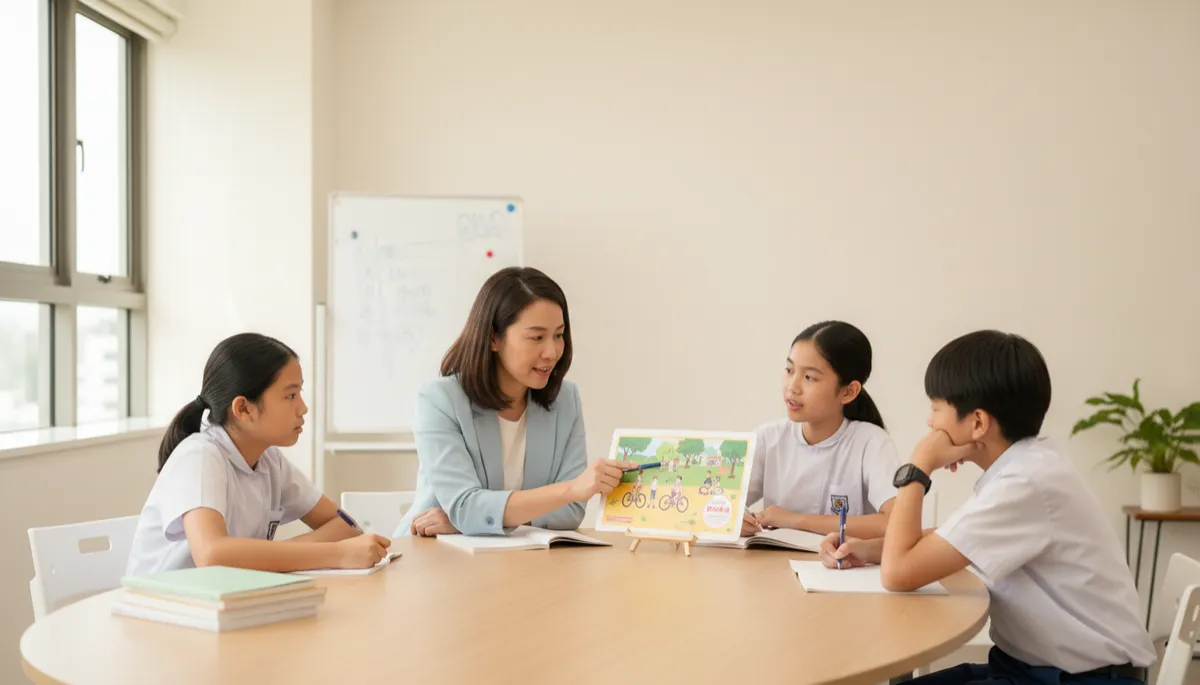
Structured group practice lets students apply proven frameworks while learning from peers.
The Group Masterclass is best suited for:
- Motivated students who are willing to do short, daily practice at home once they know the framework.
- Families who will actively reinforce learning at home — for example, asking one SBC question over dinner each night and listening for PEEL + PEERS structure.
- Students starting with at least 8+ weeks before the exam, so there is time to learn, practise, and refine.
Private vs Group: Which Is Right for Your Child?
Both private and group PSLE oral tuition can work. The right choice depends on your child’s personality, current level, timeline, and your budget. Use this simple decision guide:
- (a) Specific identified weakness → Private. If you already know the issue — freezing, monotone reading, very short answers, or heavy Singlish — 1‑on‑1 coaching lets Hakim attack that problem directly and repeatedly until it changes.
- (b) General preparation with time to spare → Group. If your child is average or slightly above average, and you have a few months, a Group Masterclass gives them a strong framework and plenty of practice at a lower cost per hour than private.
- (c) Shy or anxious child → Private. Some children shut down when others are watching. In a private setting, there is no peer comparison, no embarrassment, and progress can be much faster because the environment feels safe and focused.
- (d) Sociable child who learns by observing → Group. If your child naturally watches others, copies good models, and enjoys friendly competition, a small group can be very powerful. They see what a strong answer sounds like and immediately try to match it using the same framework.
- (e) Under 4 weeks to exam → Private. With limited time, you cannot afford “warm‑up” weeks. Private coaching compresses months of practice into days because each session is pure, targeted speaking practice with instant correction. This is how students jump from 28/40 to 36–40/40 in a short window.
- (f) Budget‑primary decision → Group. If your top constraint is budget, a $1,000 Masterclass will still give your child a complete system and repeated practice opportunities — far more strategic than spreading the same amount thinly across random hourly lessons.
The 6‑Point Checklist for Choosing Any PSLE Oral Tutor
Whether you work with Hakim or another tutor, use this checklist to protect your child’s time and your budget. A strong PSLE oral specialist Singapore tutor should meet all six points — not just one or two.
- Oral specialisation — not oral as an add‑on. Ask directly: “Do you specialise in oral, or is this just one small part of your English tuition?” If oral is squeezed into the last 10 minutes of class, your child will not get enough practice to move from average to distinction.
- Post‑2025 format knowledge. The tutor must be fully familiar with the current format: 40‑mark weighting, photograph‑based SBC with three independent questions, given situation for Reading Aloud, and no sub‑prompts. If they are still teaching old poster‑style SBC or linked themes, that is a red flag. You can read more about the new format in this PSLE Oral Exam Guide.
- A named, teachable framework for SBC answers. “Just practise more” is not a framework. Look for clear systems like PACT, PEEL, and PEERS that your child can remember under stress. Frameworks turn a blank mind into a step‑by‑step plan on exam day. For a deeper breakdown of effective structures, see How to Score AL1 for PSLE Oral.
- Parent communication built into every session. You should never have to chase the tutor for updates. A good tutor takes 3–5 minutes each time to explain what was done, what improved, and what to practise at home. This is standard in Hakim’s programmes because parents are partners, not spectators.
- Specific documented results. Look for concrete outcomes: “90% of students scored 27/30+” or “students improved from 28/40 to 36–40/40 within X weeks.” Vague testimonials like “my child improved a lot” are not enough. Ask for before‑and‑after scores, especially for students who started late or were very anxious.
- Genuine‑answer methodology — not memorised scripts. The current PSLE Oral format is designed to break memorised answers. With three independent questions and no sub‑prompts, scripts fall apart as soon as the examiner asks something unexpected. Your child must learn to give authentic, flexible answers using a framework — not word‑for‑word essays.
Is It Too Late?
Parents often ask, “My child is already in P6. Is it too late to start PSLE oral tuition?” The honest answer: earlier is always better — but it is almost never too late. Here is a realistic timeline for 2027 PSLE Oral preparation with a specialist framework:
- P5 start (12+ months): Ideal. Your child builds natural confidence, strong pronunciation, and a wide bank of personal experiences to draw from. By P6, they are simply refining and maintaining. This is how students comfortably target AL1 for oral.
- P6 Term 1–2 (10–14 weeks): Excellent. There is time to teach PACT, PEEL, PEERS, correct major habits, and run multiple full mock exams. Students can move from uncertain to confident within a term, especially with consistent home practice.
- June holidays (~8 weeks): Strong. With focused weekly lessons and daily 10–15 minute home practice, students can still see big jumps in clarity, content, and confidence before the actual oral exam period in August.
- July (~4 weeks): Significant improvement possible. At this stage, the priority is high‑impact corrections: removing short answers, teaching a clear structure, and rehearsing exam conditions. Many of Hakim’s students have gained 6–8 marks in this window alone.
- August (days before): Still not too late. Because the framework is fast to learn, even students who join days before the exam have scored 38/40 and 40/40. The reason is simple: once a child knows exactly how to start, develop, and conclude each answer, their confidence rises immediately. They are no longer guessing; they are following a system.
What Singapore Parents Say
Hakim’s methods are grounded, practical, and focused on results. Here is what some Singapore parents have shared about their children’s experiences in his specialist PSLE oral tuition programmes:
“We stay in Tampines and my son always ‘mumbled’ during oral. His teachers said he was shy and there was nothing much to do. After four sessions with Hakim, even I was shocked at how clearly he read and how confidently he could talk about the picture. His prelim oral jumped from 28/40 to 37/40. The biggest change was his confidence — he now says, ‘I know what to say already.’”
— Mother of P6 boy, Tampines
“My daughter from Nan Hua Primary in Clementi was already doing well in English but kept scoring around 30/40 for oral. We wanted to push her into the high 30s. Hakim’s PACT and PEEL frameworks gave her a clear way to organise her thoughts. In the actual PSLE, she scored 37/40 for oral. She told me the questions were different from what she practised, but she ‘just used the same structure.’ That’s when I knew the method really works.”
— Father of P6 girl, Clementi (Nan Hua Primary)
“My son in Punggol is very quiet and used to answer in one or two sentences only. He dreaded oral exams. In Hakim’s 1‑to‑1 sessions, he was given space to speak without being compared to classmates. Hakim patiently showed him how to expand his answers using his own hobbies and experiences. By the time PSLE came, his teacher commented that he was ‘a different child’ during oral. He walked out of the exam smiling for the first time.”
— Mother of P6 boy, Punggol
“We live in Bishan and only found Hakim 10 days before oral. Honestly, I thought it was too late but decided to try. He focused on my daughter’s reading pace and taught her exactly how to start each SBC answer confidently. In the end she scored 39/40 for PSLE oral. For such a short time, the improvement was incredible. I only wish we had started earlier.”
— Mother of P6 girl, Bishan
You can read more about Hakim’s background and approach in the About Hakim Harsono page, including why he chose to specialise only in PSLE Oral instead of general English tuition.
Book Your Child’s Free Oral Assessment
If you have read this far, you are serious about helping your child secure strong oral marks for the 2027 PSLE. The next step is simple and low‑risk: book a free 15‑minute oral assessment with Hakim at hakimharsono.com/start.
In this short session, Hakim will:
- Listen to your child read a short passage and answer one or two SBC questions, using the current MOE/SEAB format.
- Identify specific gaps — for example, unclear pronunciation, weak content, lack of structure, or anxiety under pressure.
- Recommend whether private 1‑on‑1 or Group Masterclass will give your child the best and fastest improvement based on your timeline and budget.
There is no obligation to sign up after the assessment. Many parents simply use it as a professional second opinion on where their child stands for PSLE Oral. Hakim’s track record is clear: about 90% of his students score 27/30+ (or the equivalent 36/40+) for PSLE Oral, even under the newer, more demanding format that punishes memorised answers and rewards genuine thinking.
Whether you choose private PSLE oral tuition, a structured group PSLE oral tuition Masterclass, or another path entirely, make a deliberate decision. Oral is now 20% of your child’s English grade. With the right specialist support, it can become their strongest paper — not their biggest worry. Start by hearing exactly where your child stands today at hakimharsono.com/start.
