PSLE Oral Topics: 2015-2027 Trends & Forecast
PSLE Oral, Singapore English, Past Year Topics, 2027 Forecast
PSLE Oral Topics 2015–2027: Complete Past Year List + 2027 Forecast
A data-driven guide to PSLE oral topics Singapore past year trends and a grounded PSLE oral topics 2027 forecast, by Hakim Harsono, Singapore’s only PSLE Oral Specialist (Speak Easy).
Every August, the same questions flood WhatsApp groups and parent forums: “What came out for PSLE oral this year?” and “Any idea what MOE might test next year?” Yet official information on PSLE oral topics is surprisingly limited. As a specialist who has tracked and coached PSLE English Oral full-time since 2014, I built my own database of reconstructed topics to answer these questions with evidence, not guesswork.
This pillar article brings together 12 years of reconstructed PSLE English oral themes, a clear explanation of what changed in 2025, and a structured PSLE oral themes 2027 forecast. It is written for Singapore parents and P6 students who want to prepare intelligently, without wasting time memorising scripts that will never be tested in that exact form.
1. Does SEAB Publish Official PSLE Oral Topics? — No, and Here’s Why That Matters
The Singapore Examinations and Assessment Board (SEAB) publishes the PSLE English Language Syllabus (Syllabus 0001) and the official exam format. However, SEAB does not publish the specific Stimulus-Based Conversation (SBC) photographs, posters, or question wordings used in any PSLE year. Once the exam is over, the exact materials are not released to the public, in line with SEAB’s policy of protecting exam integrity and reusability of question types (seab.gov.sg).
What SEAB does share publicly is the purpose of the oral exam: to assess students’ reading aloud and conversational skills using familiar, age-appropriate contexts such as school life, family, community, and current issues (SchoolBag). SEAB has also clarified in 2026 media replies that students are not expected to memorise technical vocabulary and are not penalised for not naming specific items like “crowbar”; instead, they are assessed on clarity, reasoning, and ability to express opinions (SEAB Media Replies 2026).
Because there is no official topic list, the “PSLE oral topics Singapore past year” databases you see online — including mine — are reconstructions, not leaked answer keys. They are built by:
- Collecting post-exam reports from P6 students immediately after each oral day.
- Cross-checking details across multiple schools and centres to remove obvious memory errors.
- Comparing with public commentary from MOE/SEAB when available (for example, 2026 Chinese Oral themes on safety and honesty were confirmed in media replies).
For a full breakdown of format, timing, and scoring bands, see my companion guide: PSLE Oral Exam Guide Singapore.
2. What Changed in 2025: From Poster to Photograph (Why This Shift Matters)
Before 2025, the English SBC stimulus was typically a designed poster with clear text: a title, slogans, event details, sometimes bullet points. For example, a 2019–2022 style prompt might show a colourful poster titled “Community Day at the Park” with phrases like “Help your neighbours”, “Games for children”, and “Free health screening”. Students could rely heavily on the visible words to structure their answer and infer the theme (community, helping others, healthy lifestyle, and so on).
From 2025 onwards, based on consistent student reports and tuition-centre databases, the PSLE English SBC shifted to real-life photographs with no visible text clues. The 2025 stimulus, for example, was widely reported as a photograph of people enjoying hawker food — the same broad theme on both days. In 2026, students reported black-and-white photographs of:
- Children playing at a neighbourhood playground (play, leisure, community).
- A crowded public bus (public transport, consideration for others).
The themes — community, helping others, safety, healthy lifestyle — did not suddenly change. What changed was how those themes are presented. Instead of reading off a poster about “Community Events”, your child now has to interpret a realistic scene: neighbours helping an elderly man with groceries, a student giving up a seat on the MRT, or a family cycling together in a park. This demands stronger skills in:
- Observation (What exactly is happening in the photograph?)
- Inference (What values or issues does this scene suggest?)
- Transfer (How does this connect to my own experiences and opinions?)
This shift is one reason I emphasise flexible story-building rather than memorising poster-specific answers. We will return to this in Sections 6 and 7, and in more depth in How to Score AL1 for PSLE Oral.
3. PSLE English Oral Topics: 2015–2026 Complete Reconstructed List
The table below summarises 12 years of reconstructed PSLE English oral themes. Remember: this is not an official SEAB release. It is a carefully cross-checked reconstruction based on student and parent reports, combined with patterns from MOE curriculum emphases and public commentary. Where two themes look similar, I have chosen umbrella labels that capture the core idea tested that year.
| Year | Day 1 Theme | Day 2 Theme | Notes |
|---|---|---|---|
| 2026 | Playground / Leisure Activities | Public Transport / Community | Real photographs (B&W). Strong focus on consideration and safety on public transport; aligns with SEAB’s emphasis on familiar daily life themes and values. |
| 2025 | Food and Hawker Culture | Food and Hawker Culture | First year of photograph format. Same broad theme across both days, likely to test depth of discussion on Singapore food culture, family meals, and community spaces. |
| 2024 | Health and Exercise | Community Service | Likely final poster year. Strong post-Covid emphasis on physical health, active lifestyle, and helping others in the community. |
| 2023 | Technology | Environment and Nature | Technology theme focused on devices and online learning; environment theme included parks, recycling, and nature appreciation. |
| 2022 | School Life | Family Memories | Strong emphasis on reflection: favourite school events, CCA, and meaningful family experiences. |
| 2021 | Neighbourhood Life | Recreation and Leisure | Covid-era themes involving safe outdoor activities, neighbourhood facilities, and considerate behaviour in shared spaces. |
| 2020 | Learning and School | Helping Others | Heavy focus on values: resilience in learning and kindness in supporting classmates, family, and community. |
| 2019 | Sports and Fitness | Community and Neighbourhood | Linked to national pushes for healthy living and active community engagement in public spaces. |
| 2018 | Food Culture | Technology and Daily Life | Early appearance of hawker and cafe scenes; technology questions on screen time and online communication. |
| 2017 | Family Bonds | Environmental Awareness | Questions often asked about spending time with grandparents and protecting nature spots in Singapore. |
| 2016 | School Experiences | Recreation | Typical questions on favourite lessons, CCAs, and how students relax during weekends or holidays. |
| 2015 | Community Values | Health and Wellbeing | Earliest reconstructed year in this dataset; themes already show community and health as core pillars. |
4. Pattern Analysis: The 4 Most Recurring Topic Clusters
When we aggregate the 2015–2026 data, clear clusters emerge. Instead of treating “Neighbourhood Life”, “Community Service”, and “Helping Others” as separate, we group them into broader clusters that reflect the underlying values and contexts. This is the crucial step that turns a raw past-year list into a meaningful PSLE oral themes 2027 forecast.
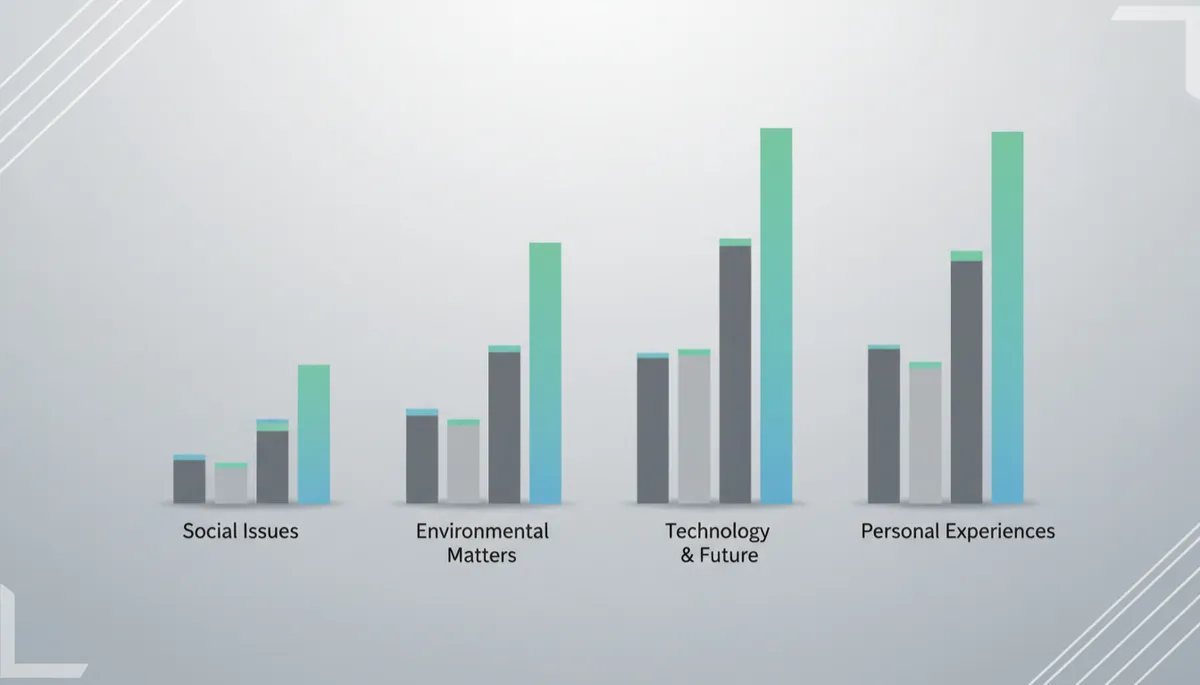
Community and helping others dominate PSLE oral themes, with food, family, and school close behind.
Cluster 1: Community and Helping Others — 9 out of 12 Years
This is the single most consistent cluster. In some form — neighbourhood life, community service, helping others, public transport courtesy, community values — it appears in 9 of the 12 years in our dataset. Even in years where the headline theme is “sports” or “playground”, the deeper questions often turn towards values: helping a friend who is left out, showing consideration in shared spaces, volunteering, or supporting neighbours in need.
Cluster 2: Family and Intergenerational Relationships — 7 out of 12 Years
Themes labelled as “Family Bonds”, “Family Memories”, or questions about celebrations and home routines fall into this cluster. Across 7 of 12 years, students have been asked to talk about:
- Time spent with parents, siblings, or grandparents.
- Traditions such as family dinners or festive preparations.
- Learning values or skills from older relatives.
This aligns with MOE’s long-standing emphasis on family as a core support system and on respect for elders in Singapore society.
Cluster 3: School Life — 6 out of 12 Years
School is the most familiar environment for P6 students. It is therefore unsurprising that “Learning and School”, “School Life”, and “School Experiences” appear in half the years in our data. These questions typically explore:
- Favourite subjects and why they matter.
- CCAs, school events, and leadership roles.
- Challenges in learning and how students overcame them.
Cluster 4: Food and Culture — 5 out of 12 Years (Rising After 2025)
Food has always been a natural conversation topic in Singapore, but there is a clear uptick from 2018 onwards, especially with the 2025 hawker-culture photographs. Across 5 of 12 years, students encountered themes involving:
- Hawker centres and local dishes.
- Family meals and celebrations centred around food.
- Healthy eating and lifestyle choices.
This aligns with national conversations on hawker culture as intangible heritage and on healthy living campaigns.
Supporting Clusters: Environment and Technology — 3–4 Appearances Each
Environment and Technology appear less frequently than community or family, but they are strategically important:
- Environment themes (parks, recycling, nature) appear 3–4 times, often linked to broader national efforts like the Singapore Green Plan and school-based environmental programmes.
- Technology appears similarly often, focusing on devices, online learning, and screen time — but notably, not yet as a full “Technology and AI” future-of-work theme.
5. 2027 Topic Forecast: The 5 Highest-Probability Themes
No one outside SEAB can guarantee the exact 2027 topics. However, by combining 12-year trend data with MOE/SEAB public statements and broader national priorities, we can make a reasoned PSLE oral themes 2027 forecast. Here are the five highest-probability clusters I am preparing my 2027 students for.
1. Technology and AI — OVERDUE, Very High Probability
Despite technology appearing in 2018 and 2023, AI has never been the primary English oral theme, even though it has dominated education, work, and national conversation since around 2023. Given the rapid adoption of digital tools in schools and the push for students to be “future-ready”, a 2027 PSLE oral topic centred on Technology and AI in daily life is highly probable.
Expect photographs involving:
- Students using tablets or laptops in class or at home.
- Robots or automated machines helping with tasks (cleaning, serving food, assisting elderly).
- Families interacting over screens — video calls with relatives, online games, or messaging.
2. Community and Helping Others — NEAR-CERTAIN in Some Form
With 9 appearances in 12 years, this cluster is as close to “guaranteed” as we can get. Even when the surface topic looks like “playground” or “public transport”, the deeper questions almost always touch on:
- Helping strangers, classmates, or neighbours.
- Being considerate in shared spaces (lifts, buses, playgrounds, hawker centres).
- Volunteering and community activities organised by schools or grassroots groups.
Even if 2027’s headline theme is technology or environment, helping others is very likely to appear as a secondary question: “Have you ever helped someone in a similar situation?” or “What can students do to support others in your community?”
3. Environment and Sustainability — OVERDUE, High Probability
Environment themes have appeared only about 2–3 times directly in 12 years, but the Singapore Green Plan 2030, school-based environmental programmes, and global climate discourse make sustainability a strong candidate for PSLE oral topics 2027. Expect photographs involving:
- Recycling corners, beach clean-ups, or park clean-up activities.
- Community gardens or rooftop farms in HDB estates or schools.
- Families or students using reusable bags, bottles, or containers.
4. Family and Intergenerational Relationships — REGULAR CYCLE, Due in 2027
With 7 appearances in 12 years, family-related themes follow a regular cycle: they may not appear every single year, but they return often enough that skipping them in preparation is risky. After a period where community and health dominated, 2027 is statistically due for a renewed focus on family and intergenerational ties.
Likely angles include:
- Grandparents teaching traditional skills (cooking, crafts, games, stories).
- Multigenerational households and how family members support each other.
- Family celebrations and how they build bonds.
5. Cultural Festivals and Racial Harmony — DARK HORSE, Live Possibility
Surprisingly, in 12 years of reconstructed data, cultural festivals and racial harmony have never been the primary English oral theme, even though they are central to Singapore’s identity and frequently discussed in Social Studies and Character and Citizenship Education. This is now the longest non-appearance streak for any major cluster — which actually increases its probability as a “fresh” theme in 2027 and beyond.
If this cluster appears, expect photographs of:
- Chinese New Year, Deepavali, or Hari Raya gatherings in homes or community spaces.
- School Racial Harmony Day activities or cultural exchange booths.
- Friends of different races sharing food or playing together.
6. How to Actually Prepare for Any Topic (Without Memorising Scripts)
Many parents approach PSLE oral topics 2027 preparation by asking tutors to “cover” 5–10 popular themes — technology, family, environment, and so on — and then drilling their child to memorise a model answer for each. This feels safe, but it fails for two reasons:
- The exact wording of the 2027 questions is unknown and will not match any script perfectly.
- Examiners can hear when a child is reciting; it usually leads to weaker interaction, slower thinking, and lower scores in the “personal response” band.
Instead of memorising 5 topic-specific scripts, I train students to build 5 flexible personal stories that can stretch across multiple clusters. Each story is crafted with four anchors:
- A specific person (named) — “my grandmother, Nani”, “my form teacher, Mr Lim”.
- A specific place — “the playground below my block”, “Tekka Market”, “our school hall”.
- A specific time — “last December holidays”, “during Primary 5 camp”, “on the first day of Ramadan”.
- A specific emotion — “I felt nervous but excited”, “I was embarrassed at first”, “I felt proud and grateful”.
With these anchors, the same story can answer different questions. For example, one story about helping your grandmother prepare for Deepavali can be used for:
- Family — “How do you spend time with your family members?”
- Cultural festivals — “Tell me about a festival that is meaningful to you.”
- Intergenerational relationships — “Do you think it is important to learn from older people?”
- Community — “How can festivals bring people together in Singapore?”
This approach works regardless of whether the 2027 photograph shows a robot serving food, a recycling drive, or children playing at a void deck. Your child is not trying to recall a perfect script; they are selecting the most relevant story from their “library” and adapting it on the spot — exactly what SEAB says the oral exam is designed to test.
7. The 5 Stories Every P6 Student Should Have Ready for 2027
Based on the 2015–2026 data and the PSLE oral topics 2027 forecast above, these are the five core stories I require every P6 student in my Speak Easy programmes to prepare. Together, they can cover 80% or more of probable Question 2 and Question 3 scenarios.
Story 1: A Time You Helped Someone Outside Your Family
This story targets the dominant community and helping others cluster. It could be:
- Helping an elderly neighbour carry groceries up the stairs when the lift was under maintenance.
- Staying back after CCA to help a junior pack up equipment.
With PEERS, your child can explain what happened, reflect on how they felt, and suggest what other students can do in similar situations.
Story 2: A Meaningful Experience with a Grandparent or Older Relative
This covers the family and intergenerational cluster and also supports cultural festivals and values. Examples include:
- Learning to cook a traditional dish with your grandmother for Hari Raya, Deepavali, or Chinese New Year.
- Listening to your grandfather share stories about his childhood in kampong days.
Story 3: A School Experience That Taught You Something Unexpected
This story links to school life, but can also support themes of resilience, teamwork, leadership, and values. Strong examples are:
- Failing a test but learning how to manage your time better afterwards.
- Organising a class event where something went wrong, and how you and your classmates solved it.
Story 4: A Time You Used or Encountered Technology Differently Than Expected
This prepares for the likely Technology and AI angle. Suitable stories include:
- Using a learning app or AI tool that helped you understand a topic better than before.
- Realising you spent too much time on games, and how you changed your habits.
This story can be easily adapted to questions about screen time, online safety, AI in jobs, or digital communication with friends and family.
Story 5: A Moment You Noticed Something About Singapore — Food, Culture, Diversity, or Pace of Life
This final story is a flexible “Singapore lens” that ties together food, culture, racial harmony, and even environment. Examples:
- Visiting a hawker centre and noticing how people of different races enjoy each other’s food.
- Joining a school outing to a heritage trail, museum, or nature reserve and learning something new about Singapore.
8. Book a Free Assessment & Download the 2027 Topic Forecast PDF
Past-year data is only useful if it translates into clear, confident performance in front of an examiner. If you would like a professional, personalised view of how ready your child is for PSLE oral topics 2027, you can book a free 1-to-1 assessment with me and my team at Speak Easy.
During this 30-minute session, we will:
- Run your child through a realistic 2027-style photograph SBC prompt, based on the forecast clusters above.
- Identify strengths and gaps in observation, personal response, and language range.
- Recommend a targeted story-building plan using the five core stories and PEEL/PEERS frameworks.
You will also receive a complimentary 2027 Topic Forecast PDF, summarising:
- The full 2015–2026 reconstructed topic table for quick reference.
- Visual charts of theme frequencies and cluster trends.
- Ready-to-use practice question sets for Technology & AI, Environment & Sustainability, and Cultural Festivals & Harmony.
To secure your free assessment slot and download the PSLE oral topics Singapore past year and 2027 forecast PDF, visit hakimharsono.com/start. Slots are limited each term to maintain quality of feedback, so I recommend booking early in the year, well before the oral exam window.
Whether you work with me or prepare on your own, use this article as a strategic map: understand the patterns, forecast intelligently, and then focus on what examiners truly reward — clear thinking, genuine stories, and the confidence to respond to any photograph the 2027 PSLE may present.
