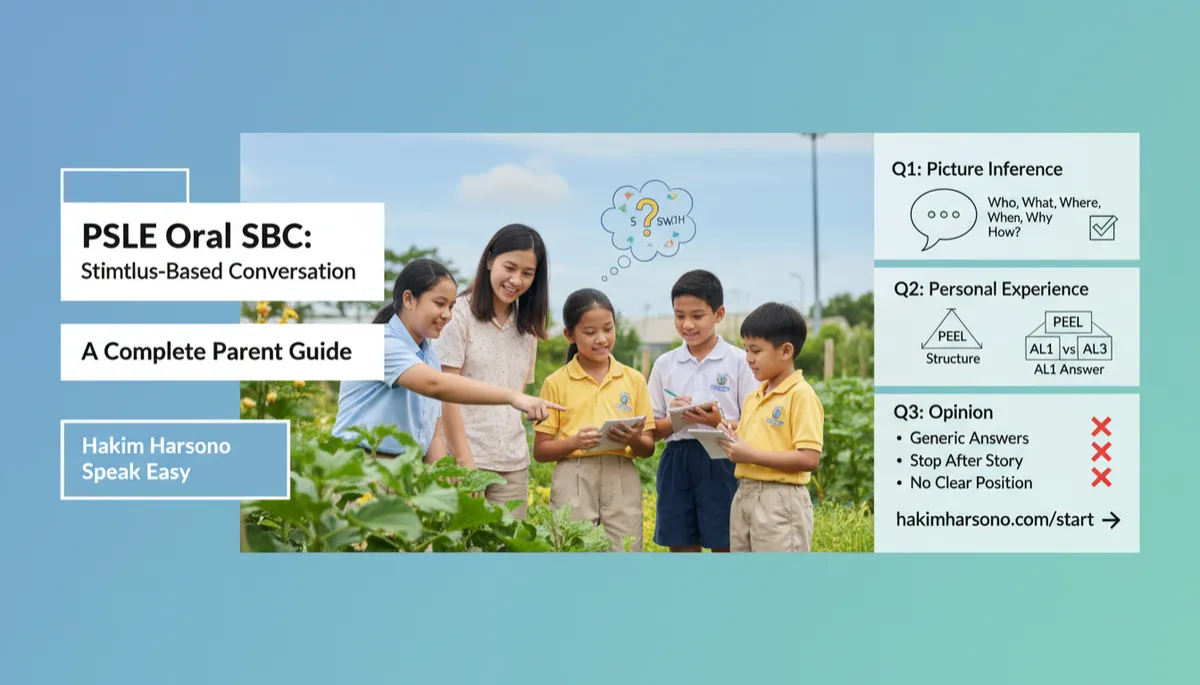
Guide to Mastering PSLE Oral SBC for Parents
PSLE, PSLE oral SBC Singapore, stimulus-based conversation PSLE
PSLE Oral Stimulus-Based Conversation (SBC): A Complete Parent Guide
By Hakim Harsono, Speak Easy — for Singapore parents who want a clear, practical roadmap to help their child excel in the new PSLE stimulus-based conversation (SBC).
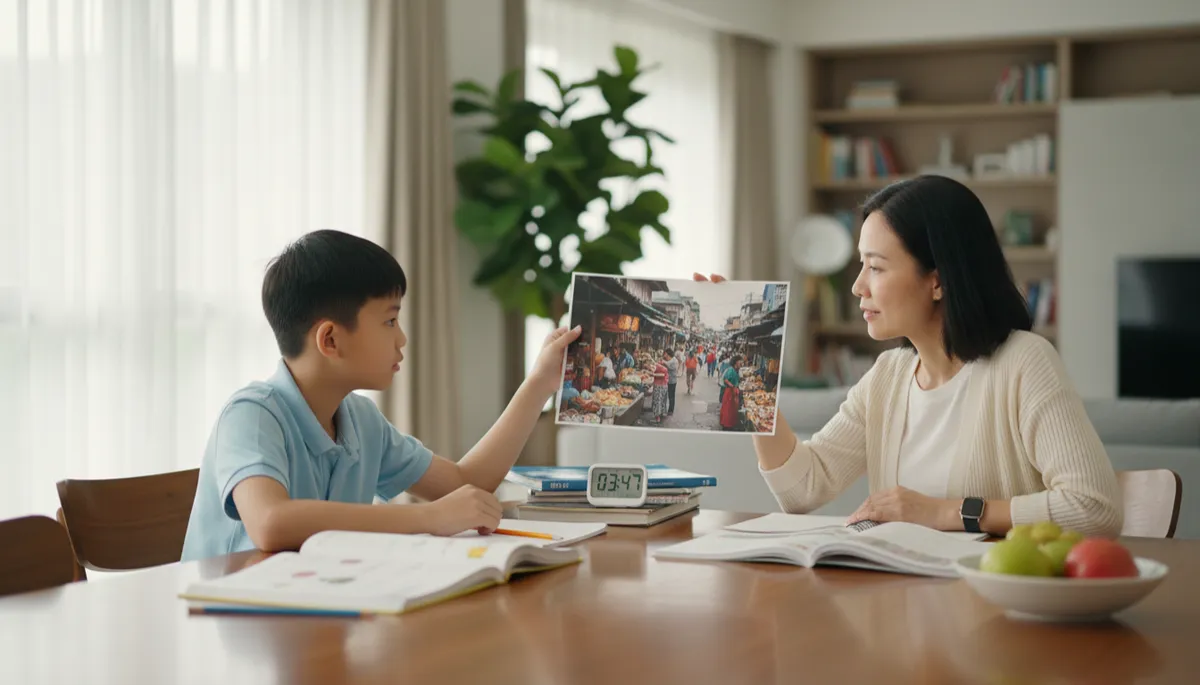
1. What Exactly Is the PSLE SBC Component?
From 2025 onwards, the PSLE English Oral paper is 40 marks, and the Stimulus-Based Conversation (SBC) now takes up 25 marks — more than half of Oral and 12.5% of the overall English grade (MOE, SEAB; psleprep.sg, pslejourney.com). For many children, SBC is now the make-or-break section for achieving AL1–AL2 in English.
In the new format, your child no longer talks about a poster with words. Instead, they have a real-life photograph as the starting point. The examiner will ask three standalone questions:
- Q1 (7 marks): Picture inference — what is happening in the photograph?
- Q2 (9 marks): Personal experience related to the theme.
- Q3 (9 marks): Opinion / critical thinking question.
2. The Photograph & 5-Minute Prep: Using 5W1H
The photograph is usually a familiar Singapore scene. Common themes include:
- Community scenes — residents at a void deck event, recycling drive, charity fair.
- Family moments — family cooking together, visiting grandparents, eating at a hawker centre.
- Neighbourhood settings — playground, park, library, MRT station, wet market.
- School activities — CCA, camp, VIA projects, Sports Day, learning journeys.
During the 5-minute preparation time, students cannot write notes, but they can think strategically. Teach your child to silently run through 5W1H:
- Who is in the picture? (age, relationship, roles)
- What are they doing? (main action, smaller actions)
- Where is this taking place? (school, HDB estate, park)
- When is it? (time of day, occasion, season)
- Why might this be happening? (purpose, motivation)
- How do the people feel? (emotions, reactions)
This habit of careful observation makes Q1 smoother and gives material for Q2 and Q3 later. It also trains genuine visual inference — a key aim of the PSLE oral SBC Singapore format.
3. Q1 (7 Marks): Picture Inference with 5W1H
Q1 usually sounds like: “Tell me what you can see in this photograph.” An AL1 answer does more than list items. It infers and uses 5W1H smoothly.
Sample Q1 answer (Playground safety theme):
“In this photograph, I see a group of children playing at a neighbourhood playground under a HDB block. On the left, two boys are taking turns on the slide while a girl is waiting patiently behind them. They look excited and are smiling, so I think they are enjoying themselves after school. In the background, there is a mother sitting on a bench, keeping an eye on her younger daughter who is on the swing. This suggests that the parents are responsible and want to make sure their children play safely. The weather seems sunny and the children are in their school uniforms, so this is probably in the late afternoon on a weekday. Overall, the picture shows children having fun while still being supervised by adults.”
Notice how the answer covers who, what, where, when, why and how, with feelings and inferences, not just “There is a boy… there is a girl…”.
4. Q2 (9 Marks): Personal Experience with PEEL
Q2 links the picture to your child’s own life. A common format is: “Tell me about a time when you…” Top students use the PEEL structure:
- P – Point: One clear answer to the question.
- E – Example: A specific story with names, place, time.
- E – Elaborate: Feelings, thoughts, what you learnt.
- L – Link: Tie back to the question or theme.
Sample Q2: “Have you ever helped to organise an activity in your neighbourhood? Tell me about it.”
AL3-type answer (weaker):
“Yes, I have. My RC organised a recycling drive and I helped. I collected newspapers and bottles from my neighbours. It was fun and I learnt that we should protect the environment.”
This answer is too general. There is a story, but little detail or reflection. Now compare it with an AL1-style PEEL answer:
AL1-style answer:
“Yes, I helped to organise a recycling drive in my neighbourhood last June. (Point) My Residents’ Committee planned a ‘Green Saturday’ event at the void deck, and I volunteered with my parents. On the actual day, I went door to door with my friend Amir from the fifth floor to collect old newspapers and plastic bottles. One elderly neighbour told us she was glad we came because she could not carry the heavy stack herself. (Example) I felt proud that, even as children, we could make a real difference to someone’s day. I also realised that many residents wanted to recycle but did not know where to start. (Elaborate) This experience taught me that small community projects can bring neighbours together and make it easier for everyone to protect the environment, just like the people in the photograph are doing their part. (Link)”
5. Q3 (9 Marks): Opinion with PEERS
Q3 is where many students lose marks. The examiner may ask: “Do you think…” or “How important is…” Here, your child must take a clear stand and support it. I teach the PEERS structure:
- P – Point: Your opinion, clearly stated.
- E – Explain: Give a reason or two.
- E – Experience: Add a short real or realistic example.
- R – Reflect: Share what this shows or why it matters.
- S – Summarise: Re-state your stand in one sentence.
Sample Q3: “Do you think children should spend more time helping in the community?”
AL1-style PEERS answer:
“Yes, I strongly believe children should spend more time helping in the community. (Point) When we volunteer, we learn to be more responsible and considerate, instead of only thinking about ourselves. (Explain) For example, during my school’s Values-in-Action project, my class visited a nearby nursing home to play games with the residents. At first, I felt awkward, but when one uncle shared stories about his childhood, I realised he was just lonely and wanted someone to talk to. (Experience) That visit opened my eyes to the needs around me and made me more grateful for my own family. It also showed me that even simple actions, like listening or pushing a wheelchair, can brighten someone’s day. (Reflect) So, I think it is important for children to help in the community because it builds our character and helps us grow into caring adults. (Summarise)”
6. The 3 Biggest SBC Mistakes to Avoid
- Generic answers. Saying “It was very fun” or “I learnt a lot” without details sounds memorised. Encourage your child to name people, places, and feelings so their PSLE stimulus-based conversation answers feel real.
- Stopping after the story. Many students end Q2 or Q3 right after the event. Train them to always add what they learnt or why it matters — that reflection is where higher bands are earned.
- Not taking a clear position for Q3. Sitting on the fence (“Sometimes yes, sometimes no”) without a firm stand makes the answer weak. It is fine to acknowledge both sides, but they must still say, “Overall, I think…” and justify it.
7. Next Steps: Help Your Child Speak with Confidence
With the new PSLE oral Q1 Q2 Q3 format, strong SBC performance no longer comes from memorised scripts. It comes from clear structures (5W1H, PEEL, PEERS), specific experiences, and honest reflection — skills any child can build with the right guidance and practice at home.
If you would like a step-by-step starter kit, model answers, and video breakdowns of high-scoring SBC responses, visit hakimharsono.com/start. You will find practical resources designed for busy Singapore parents who want their child to speak confidently, naturally, and score confidently in the PSLE oral SBC Singapore examination.
