PSLE Oral Marking Rubric: Examiner Insights
PSLE English, PSLE oral marking rubric, What examiners look for PSLE oral
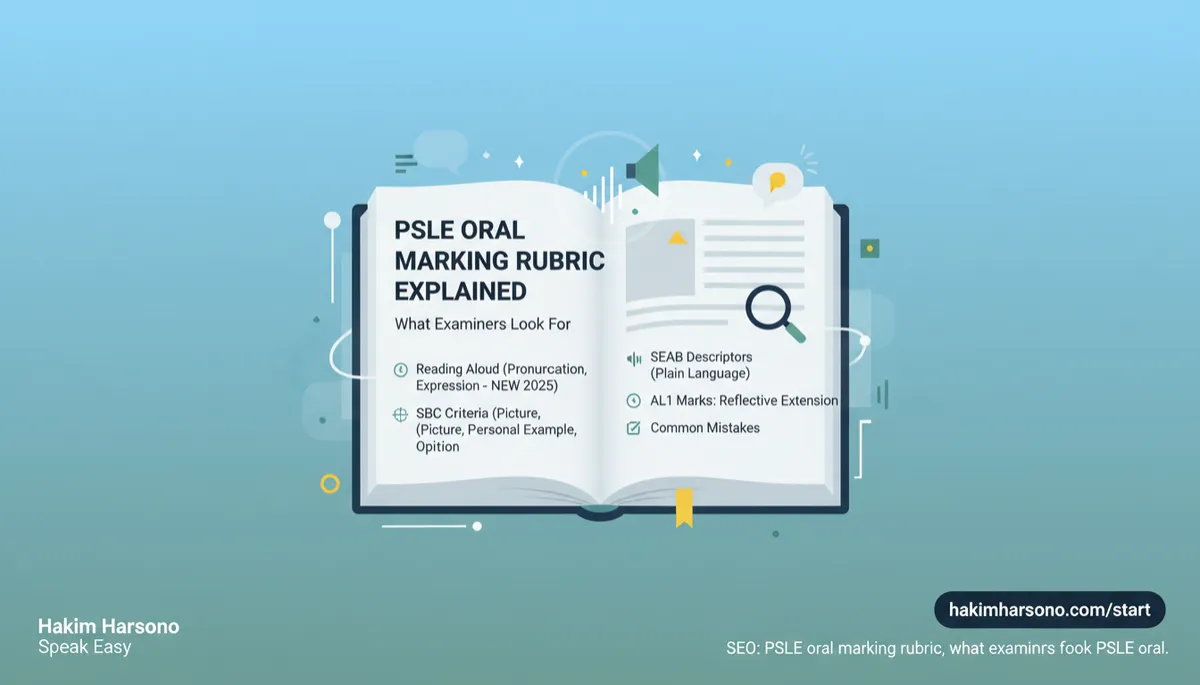
PSLE Oral Marking Rubric Explained: What Examiners Look For
By Hakim Harsono, Speak Easy — A clear, parent-friendly guide to how the PSLE oral marking rubric really works, what examiners listen for, and where AL1 marks are won or lost.

The Big Picture: What the PSLE Oral Marking Rubric Is For
The PSLE English oral paper now carries 40 marks (20% of the subject grade), split into Reading Aloud (15 marks) and Stimulus-Based Conversation, SBC (25 marks) (psleoral.sg). SEAB’s official line is simple: examiners are checking whether a Primary 6 child can communicate effectively — speak clearly, think on the spot, and respond appropriately to context (SEAB).
Reading Aloud: Three Things Examiners Listen For
The PSLE oral marking rubric for Reading Aloud focuses on three main criteria (JinBoost):
- Pronunciation accuracy – Clear consonants (especially endings like t, d, s), correct vowel sounds, and tricky words such as “chaos” or “gasped”. Occasional slips are fine; frequent or serious errors pull marks down.
- Fluency and pacing – A smooth, steady pace with natural pauses (slightly longer at full stops, shorter at commas). Examiners do not want robotic speed-reading or painfully slow, word-by-word delivery. Too many hesitations, self-corrections, or restarts signal weak fluency.
- Expression and register matched to the situation (new emphasis from 2025) – Since 2025, each passage comes with a short “given situation” that tells your child the purpose, audience and context (psleprep.sg). Examiners now ask: Does the reading sound like a speech to classmates, a news report, or a storytelling session, as stated? AL1 readers change tone, energy and emphasis to fit that situation.
SBC Q1: Picture Inference, Not Just Description
For Q1, examiners use the PSLE oral marking rubric to judge the relevance and depth of what your child says about the picture (doappliedlearning.com.sg). In plain language:
- Relevance – Comments must be clearly linked to what is actually visible. “The boy might be stressed because his table is messy and he is holding his head” is relevant. Going off into a random story that the picture does not support is not.
- Depth of inference – AL1 answers go beyond “The girl is smiling.” They infer feelings and reasons: “The girl is smiling and leaning forward, so she is probably excited to share her idea with her teammates.”
SBC Q2: Personal Example, PEEL, and Reflective Closing
Q2 moves from picture to personal experience. High-band responses show:
- Specificity of personal example – Who, what, when, where, and how your child felt. “I helped my grandmother carry groceries home from the market last Sunday when it suddenly rained” is far stronger than “I helped someone before.”
- PEEL structure – Point, Example, Explanation, Link. For parents, think: clear answer, short story, why it matters, then link back to the question. This is what PSLE oral examiner criteria call “development of ideas”.
- Reflective closing – One or two sentences on what your child learnt or will do differently. For example, “From this experience, I realised helping others does not take much time, so now I try to notice when people around me need small favours.”
That reflective closing is where AL1 marks are often won. Many students tell a story but stop abruptly. Examiners reserve the highest band for answers that show insight, not just narration.
SBC Q3: Opinion, Evidence, PEERS, and Reflective Extension
Q3 tests whether your child can give a clear opinion and support it with good reasons. In SEAB’s descriptors, high-band candidates present “clear opinions with personal connections and development” (JinBoost). In plain English, examiners look for:
- Clarity of opinion – A direct stand at the start: “I strongly agree that schools should organise more outdoor activities.”
- Quality of evidence – Not just “because it is fun”. Strong answers give reasons plus examples, sometimes including simple statistics or observations, not wild claims.
- PEERS structure – One useful way to think of an AL1 answer is: Point, Explanation, Example, Result, So-what. That final “So-what” is the reflective extension: “So, in the long run, students who spend more time outdoors may be healthier and better at handling stress.”
Again, that reflective extension is where the PSLE oral marking rubric separates “Good” from “Excellent”. It shows your child can think beyond the immediate example to a broader implication or future action.
Common Mark-Losing Mistakes Parents Should Watch For
- Memorised, one-size-fits-all scripts – Examiners are trained to spot rehearsed answers that do not truly match the question (superminds.com.sg). These usually cap a child in the “Good” band.
- Over-describing the picture, under-answering Q2 and Q3 – SBC is marked holistically. Spending too long on Q1 but giving thin, undeveloped answers later is costly.
- No reflection – Stories and opinions that end suddenly, with no “what I learnt” or “why this matters”, almost always miss AL1.
- Unnatural speaking style – Whispering, mumbling, or staring at the table can make even good content sound weak. Examiners reward natural, age-appropriate engagement.
Turn the Rubric into a Roadmap for Your Child
When you strip away the technical language, the PSLE oral examiner criteria are straightforward: clear reading matched to context, and conversations with depth, structure and reflection. If your child can consistently give specific examples, explain their thinking, and end with a thoughtful reflection or extension, they are already performing in the AL1 range for the PSLE oral marking rubric.
If you want step-by-step frameworks, model answers and targeted practice aligned to what examiners look for in PSLE oral, visit hakimharsono.com/start to get started with Speak Easy.
