PSLE Oral Exam 2027: Structure Guide
PSLE, PSLE oral exam format 2027, PSLE oral structure Singapore
PSLE Oral Exam Format 2027: The Definitive Structure Guide
By Hakim Harsono, Speak Easy — A clear, factual breakdown of what your child will experience in the PSLE English Oral (Paper 4) in 2027, so you know exactly what happens on the day and how it is marked.
1. Overview of PSLE English Oral (Paper 4) in 2027
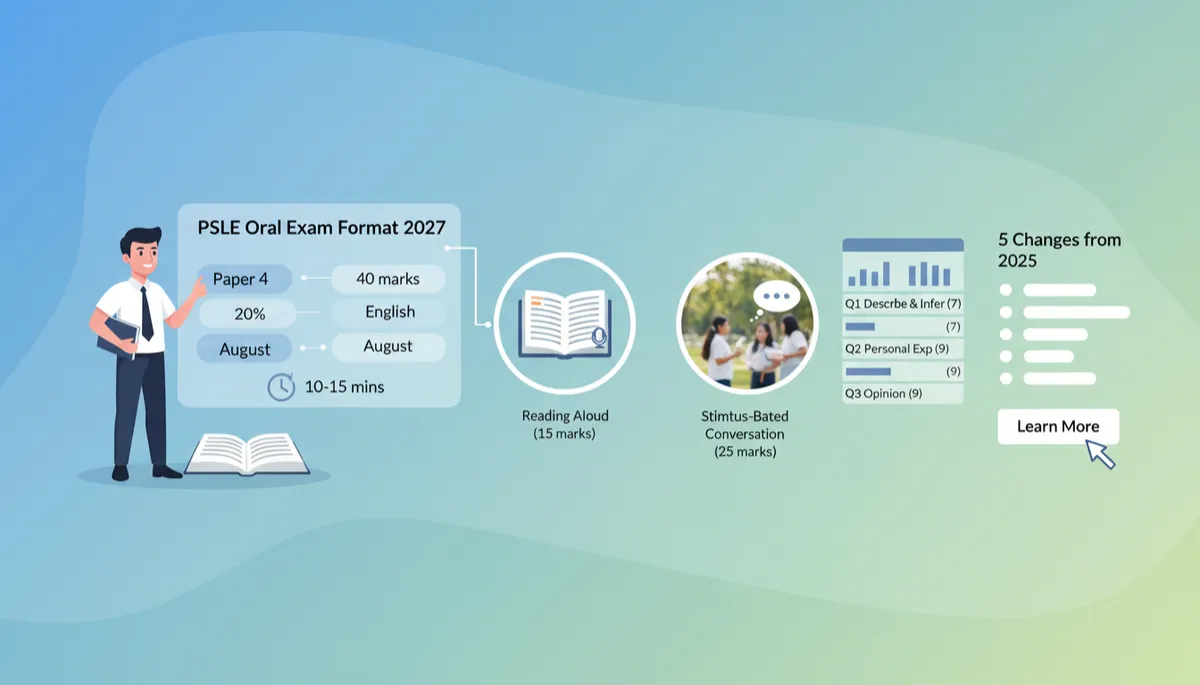
In 2027, the PSLE English Oral exam follows the Paper 4 format introduced in 2025 and maintained by SEAB for subsequent years (SEAB; psleprep.sg). It is officially called Paper 4: Oral Communication.
Key facts parents should know:
- It is worth 40 marks in total.
- These 40 marks make up 20% of the overall PSLE English grade (increased from 15% before 2025).
- It is usually held in mid to late August, ahead of Listening Comprehension and the written papers (archeacademy.com.sg).
Paper 4 has two components: Reading Aloud (15 marks) and Stimulus-Based Conversation, or SBC (25 marks). Together, they assess how clearly and appropriately your child can read and speak English in real-life contexts. When people search for “PSLE oral exam format 2027” or “PSLE oral structure Singapore”, this is the exact structure they are referring to.
2. What Happens in the Exam Room, Step by Step
The sequence on the day is standard across schools, with minor timing differences. For a typical P6 student, this is what happens:
- Reporting and waiting — Your child reports at the stated time, registers, and waits in a holding area until called to the exam room or e-oral station.
- Entry and instructions — The student enters, greets the examiner(s), and listens to brief instructions about the oral tasks and timing.
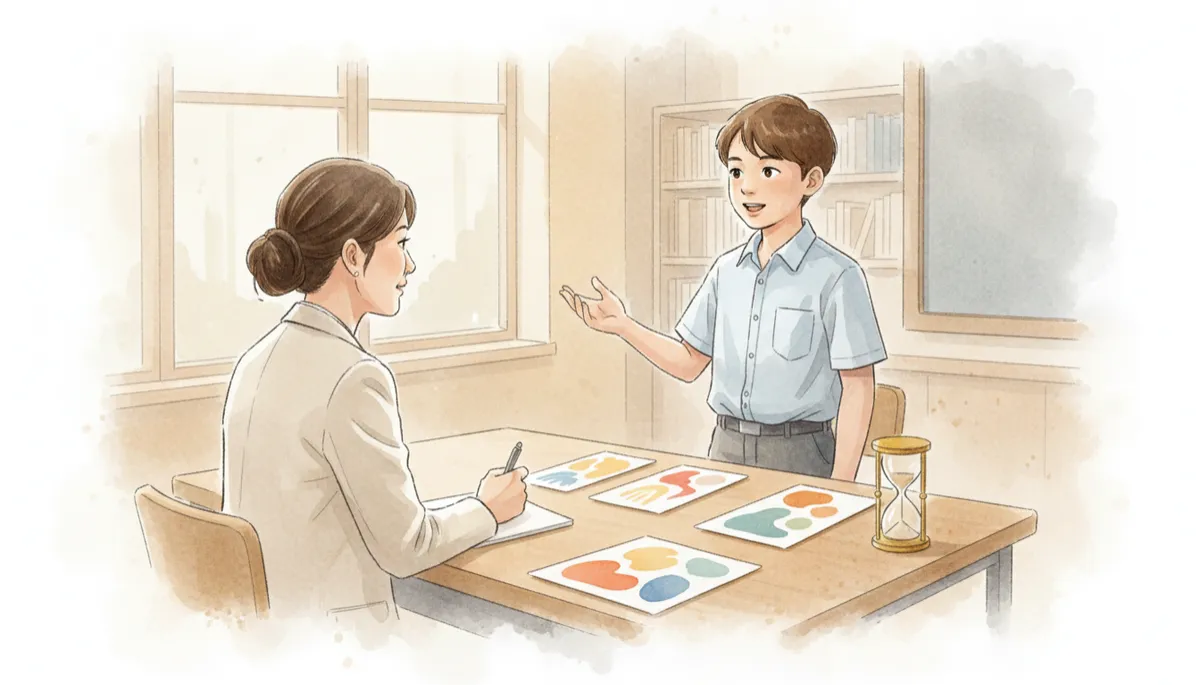
- 5 minutes of silent preparation — The student is given both the Reading Aloud passage and the SBC photograph at the same time. There is no talking during this stage. Your child reads through the roughly 200-word passage silently and studies the photograph carefully, planning what to say later.
- Reading Aloud — After the preparation time, the examiner asks the student to begin reading the passage aloud from the start to the end, in one go, unless asked to pause or repeat a line.
- Stimulus-Based Conversation — Once reading is complete, the examiner turns to the photograph and conducts the conversation using three separate questions.
No notes, textbooks, or mobile devices are allowed. The environment is kept quiet and controlled so examiners can hear each candidate clearly (SEAB rules and regulations).
3. Reading Aloud (15 Marks): What It Looks Like
The Reading Aloud passage is about 200 words. Above the passage, there is a short “given situation” preamble. This tells your child:
- Purpose — Why they are reading (e.g., sharing a story, making an announcement).
- Audience — Who they are reading to (e.g., classmates, schoolmates, a younger child).
- Context and tone — Whether the situation is formal, friendly, serious, or cheerful.
Examiners use a detailed rubric. In simple terms, they listen for four things:
- Pronunciation — Clear sounds, correct word stress, and accurate reading of common and less familiar words.
- Fluency — Smooth reading with appropriate pauses, not word-by-word or halting.
- Expression — Voice that reflects the feelings and mood in the passage, not a flat monotone.
- Register — A style of reading that matches the situation (for example, more formal for a speech, more relaxed for a story).
4. Stimulus-Based Conversation (25 Marks): Three Independent Questions
The SBC uses a real photograph without text. It might show, for example, a school canteen, a community event, or a family activity (psleprep.sg). The examiner asks three independent questions. There are no sub-prompts, and the questions are not linked to the Reading Aloud passage.
- Question 1 – Describe and infer (7 marks)
Your child describes what they see and explains what they think is happening, how people might feel, and why. This checks observation and inference skills. - Question 2 – Personal experience (9 marks)
The examiner links the theme to your child’s life (for example, “Tell me about a time you helped at home”). This assesses ability to share experiences clearly and relevantly. - Question 3 – Opinion (9 marks)
The final question asks for a view or preference (for example, “Do you think schools should organise more of such activities? Why?”). Examiners look for a clear point, simple reasons, and logical support.
5. Mark Allocation at a Glance
| Component | Sub-part | Marks |
|---|---|---|
| Reading Aloud | Single 200-word passage with given situation | 15 |
| Stimulus-Based Conversation | Q1: Describe & infer from photograph | 7 |
| Stimulus-Based Conversation | Q2: Personal experience | 9 |
| Stimulus-Based Conversation | Q3: Opinion | 9 |
| Total | 40 |
6. How Long the PSLE Oral Takes per Student
For planning purposes, parents can assume about 10–15 minutes per student in the exam room. This typically includes:
- Around 5 minutes of silent preparation with the passage and photograph.
- Around 5–10 minutes of actual reading and conversation, depending on how long your child’s answers are and how quickly the examiner moves through the questions (iworldlearning.com).
7. What Changed from 2025: Five Key Differences to Note
The 2027 format is the same as the one introduced in 2025, but many parents still compare it with the older style. Here are five important changes that came in with the 2025 overhaul and still apply:
- Higher weighting — Oral now carries 40 marks (20%), up from 30 marks (15%) previously (psleprep.sg).
- Given situation for Reading Aloud — The passage now comes with a clear situational preamble, guiding purpose, audience, and tone, instead of being read “plainly”.
- Real photograph stimulus — SBC uses a photo without text, not a poster or advertisement with words and slogans.
- Three standalone questions — Conversation now has three independent questions (inference, personal experience, opinion) with no sub-prompts. Students must develop their own responses more fully.
- No thematic link between parts — The Reading Aloud passage and SBC photograph are not thematically linked, unlike some earlier formats where both were built around one topic.
8. Next Step for Parents
Understanding the PSLE oral exam format 2027 is the first step. The next step is targeted practice that mirrors this exact structure: timed 200-word readings with a clear situation, and photo-based conversations using the three-question pattern your child will meet in the actual exam.
For a structured start, sample scripts, and model SBC answers designed for Singapore P6 students, visit hakimharsono.com/start.
