PSLE Oral Guide: Community & Helping Others
PSLE Oral, Community, Helping Others, Singapore Parents
PSLE Oral Community and Helping Others: The Complete Preparation Guide
By Hakim Harsono, Speak Easy Singapore — a warm, practical guide to help your child feel truly ready for the PSLE oral community and helping others topics.
Why the Community & Helping Others Cluster Is Almost Guaranteed
If there is one PSLE oral theme Singapore parents should prioritise, it is the community and helping others cluster. From 2015–2026, this theme has appeared in 9 out of 12 years in one form or another. It may be labelled as neighbourliness, volunteering, kindness, or kampung spirit, but the core idea is the same: how we live together and support one another in Singapore’s shared spaces. These are not random topics; they reflect core national values that MOE and the Singapore Examinations and Assessment Board want our children to internalise — care, respect, responsibility, and active contribution to society. That is why photographs in the Stimulus-Based Conversation (SBC) so often show community scenes and acts of helping others.
Likely Photograph Scenarios Your Child Should Expect
When you do PSLE oral community topic preparation at home, rehearse with pictures that look like real Singapore life. Common SBC photographs include:
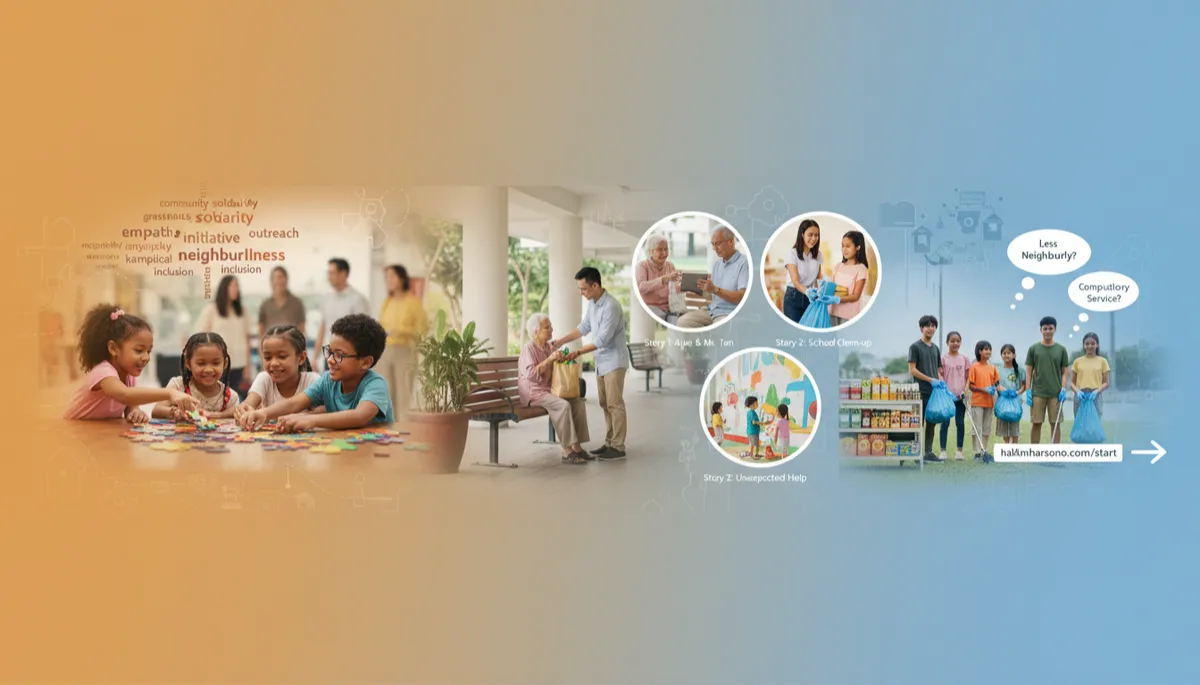
- An elderly resident being helped by neighbours at a void deck — for example, someone carrying groceries, pushing a wheelchair, or guiding an older person across the carpark. This taps into empathy, inclusion, and neighbourliness.
- Volunteers at a community clean-up or food bank — children and adults sorting food items, picking litter at a park, or joining a grassroots outreach initiative to support families in need.
- A multi-racial group of children playing together at the playground or basketball court, reflecting solidarity and harmony across races and backgrounds.
- A grassroots community event such as a block party, National Day celebration, or Residents’ Committee (RC) gathering, where neighbours mingle and participate in simple activities together.
When your child sees any of these, they should immediately think of helping others, neighbourliness, and community spirit, not just describe the picture literally.
A Handy Community Vocabulary Bank (Used Naturally)
Strong vocabulary is what separates an average response from an excellent one in PSLE oral community Singapore tasks. Instead of memorising long lists, help your child weave these words into simple, sincere sentences:
- Community, neighbourliness, kampung spirit — “This picture shows strong neighbourliness and kampung spirit in the community.”
- Solidarity, inclusion — “The children are playing together in solidarity and there is a sense of inclusion because no one is left out.”
- Grassroots, outreach, initiative — “This looks like a grassroots outreach initiative organised by the Residents’ Committee.”
- Volunteer, empathy, reciprocal — “The volunteers are showing empathy, and the help is reciprocal because the community also supports them emotionally.”
Keep sentences short and natural. The goal is warmth and clarity, not sounding like a robot.
Three Personal Stories to Prepare for Q2 (With Specifics)
Question 2 often asks, “Have you experienced something similar?” Prepare three flexible stories with a specific name, place, time, and emotion so your child can adapt quickly.
- A time your child helped a neighbour or someone they did not know well
“Last December, I helped my neighbour Aunty Lim at the Bedok North HDB lift lobby when her shopping bags tore. I felt proud and more connected to my community after carrying the bags up to her flat.” - A time your child joined a school or community service activity
“In Primary 5, my class volunteered at the Food from the Heart warehouse in Serangoon. We sorted canned food on a Saturday morning. I felt tired but satisfied because our small effort supported many families.” - A time your child received help from someone unexpected
“One rainy Tuesday evening at the Tampines bus interchange, my umbrella broke. A stranger, Uncle Raj, shared his umbrella and walked me to the MRT. I felt touched and grateful, and it reminded me that kindness can come from anyone.”
Q3 Opinion Practice Using the PEERS Structure
For Q3, guide your child to use a simple PEERS structure: Point, Explanation, Example, Result, Summary.
1. “Are Singaporeans becoming less neighbourly or more?”
Point: “I feel Singaporeans are becoming more neighbourly.”
Explanation: We have many community programmes that encourage outreach and solidarity.
Example: Mention block parties, SG Cares initiatives, or your own experience helping a neighbour.
Result: These build inclusion and kampung spirit over time.
Summary: “So overall, I think we are slowly becoming closer as a community.”
2. “Should community service be compulsory?”
Point: “Yes, I think it should be compulsory, at least in school.”
Explanation: It teaches empathy and responsibility from young.
Example: Refer to VIA projects or a school clean-up your child joined.
Result: Students see that helping others is normal, not something extra.
Summary: “Therefore, compulsory service can nurture caring citizens in the long run.”
The Community Story That Always Works: The Grandparent Connection
One powerful PSLE oral helping others story your child can reuse across many themes is about helping an elderly person with something that truly matters to them. For example:
“Every Sunday afternoon at my grandparents’ flat in Jurong West, I help my Ah Ma order groceries using a shopping app on her tablet. She feels nervous about technology, but I patiently guide her. I feel happy and closer to her because I am supporting her independence.”
This single story fits community, family, intergenerational relationships, and technology. It shows empathy, reciprocal care, and real kampung spirit within the family and neighbourhood.
Ready to Help Your Child Speak with Heart and Confidence?
With focused PSLE oral community topic preparation, your child can move beyond memorised lines and speak with genuine warmth about helping others. For more step-by-step support, model answers, and practical home practice plans, visit hakimharsono.com/start and get started today.
