
P5 PSLE Oral Prep: Start Early for AL1 Success
PSLE Oral, Primary 5, P5 PSLE oral preparation
P5 PSLE Oral Preparation: Why Starting in Primary 5 Produces AL1 Results
If your child is in Primary 5 and you are already thinking about the PSLE English Oral exam, you are exactly the kind of forward‑planning parent who can help your child secure an AL1. With the 2025 PSLE oral format giving Oral a heavier weight and more demanding tasks, starting serious preparation in P5 is no longer “kiasu” – it is simply strategic.

Why P5 Is the Secret Weapon for PSLE Oral AL1
From 2025 onwards, the PSLE English Oral exam carries 40 marks instead of 30, and now contributes 20% of the overall English grade instead of 15 (psleprep.sg). That is a one‑third increase in weight. A few marks gained or lost in Oral can now tip your child from AL2 to PSLE oral AL1 – or the other way round.
The new format also demands more spontaneous thinking, clearer expression of personal opinions, and stronger observation skills during the stimulus‑based conversation. These are not skills that can be memorised the week before Oral. They are habits of mind and speaking patterns that need time to grow.
This is where P5 PSLE oral preparation shines. With 12–14 months of gentle, structured practice, your child can make the PSLE oral framework feel automatic – so that by the time Primary 6 comes, they are not panicking about “what to say”, but calmly applying a system they already know well.
1. The P5 Advantage: 12–14 Months to Make the Framework Automatic
Think of PSLE Oral like learning to ride a bicycle. If your child only starts learning one month before a big cycling race, every practice session feels stressful. They are still trying to balance, remember where the brakes are, and avoid falling. That is what last‑minute P6 cramming feels like for many children – they are trying to learn the framework and perform under pressure at the same time.
Starting in Primary 5 gives your child a very different experience. Over 12–14 months, they can:
- Learn the PSLE oral framework slowly – how to structure answers, how to describe a picture, how to share opinions clearly.
- Practise regularly in small doses, so speaking becomes natural instead of forced or memorised.
- Build confidence step by step – from short answers to full, well‑structured responses.
When a child repeats a clear, simple framework over a year, it becomes automaticity. On exam day, instead of freezing, they instinctively know: “First I describe, then I link to my experience, then I give my opinion and explain why.” That is the P5 advantage – less panic, more control, and a much higher chance of an AL1 performance.
2. P5 vs P6 Focus: Framework Building vs Framework Applying
One of the biggest mistakes parents make is treating P5 and P6 oral preparation the same. They are actually two very different seasons with different goals – and understanding this will help you support your child more effectively.
In Primary 5: Framework Building
In P5, your child’s main job is to build the PSLE oral framework brick by brick. That means:
- Learning a simple structure for Reading Aloud – paying attention to punctuation, expression, and the “given situation” (purpose, audience, context, tone), which is now part of the 2025 format (psleprep.sg).
- Practising a clear structure for the stimulus‑based conversation – describe the picture, connect to personal experience, then share a thoughtful opinion with reasons.
- Building vocabulary and examples across common PSLE themes such as kindness, community, healthy living, technology, and school life.
At this stage, it is perfectly fine if your child is still a little slow or needs reminders. The goal is not perfection; the goal is clarity and consistency of structure.
In Primary 6: Framework Applying
By P6, the focus should shift to applying the PSLE oral framework under exam conditions. Because the structure is already familiar, your child can now work on:
- Speed and fluency – answering smoothly within the time, without long pauses or “umm… err…”
- Depth of ideas – adding specific examples, feelings, and reasons that show maturity of thought, which examiners reward generously.
- Exam stamina – staying calm and focused through Reading Aloud and three separate conversation questions, which are now standalone and not linked (psleprep.sg).
3. Turning the P5 SA2 Oral Exam into a Real Dress Rehearsal
Many parents treat the P5 SA2 oral exam as “just another test”. In reality, it can be a powerful dress rehearsal for PSLE – if you debrief it properly with your child.
Step 1: Reconstruct the Experience Calmly
When your child comes home after SA2 Oral, resist the urge to ask, “Did you do well?” Instead, gently ask:
- “What was the Reading Aloud passage about?”
- “What picture did you see for the conversation?”
- “What questions did the teacher ask you?”
Let your child talk freely. This helps them process the experience and remember the details, which you can then use for targeted improvement.
Step 2: Identify One Strength and One Growth Area
Ask your child:
- “What do you think you did well?”
- “If you could do it again, what is one thing you would do differently?”
This encourages a healthy, reflective mindset – the same mindset that top PSLE performers use. Instead of feeling helpless, your child learns that every exam is a learning opportunity.
Step 3: Replay the Exam at Home with the PSLE Oral Framework
Using your child’s memory of the SA2 stimulus and questions, recreate the exam at home. This time, guide them to answer using a clear PSLE oral framework:
- For the picture: overview → key details → inferences (feelings, reasons) → link to self.
- For personal and opinion questions: clear point → explanation → example → closing sentence.
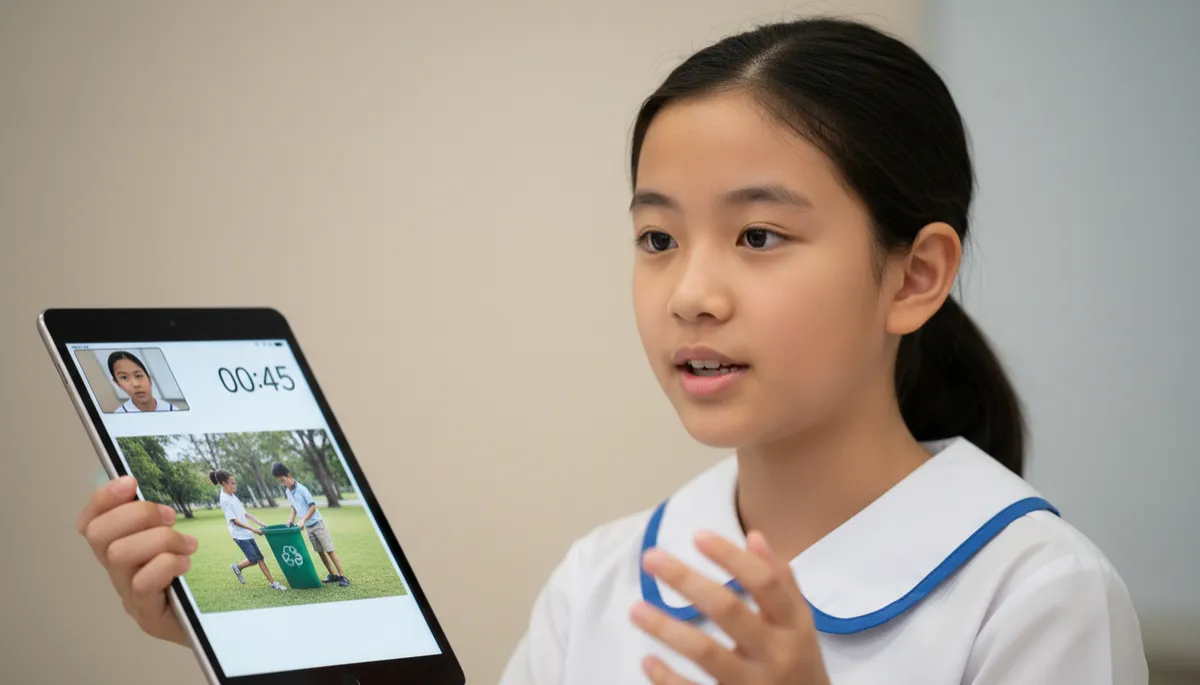
Short, regular mock orals help P5 students turn exam skills into steady habits.
4. P5 vs P6 Start: Consistency, Confidence, and Automaticity
Parents often ask, “If we start in P6, can my child still get AL1 for Oral?” The honest answer is: yes, it is possible – but it is much harder, and it usually requires more intensive, stressful work for both child and parent. Starting in P5 makes the journey smoother and more encouraging in three key ways.
Consistency
A child who starts P5 PSLE oral preparation can afford to practise just 10 minutes a day. Over a year, that adds up to more than 60 hours of targeted speaking practice – without overwhelming your child or clashing with other subjects. In contrast, a P6‑only start often means last‑minute “chiong” sessions that feel like punishment, not progress.
Confidence
Children who speak regularly in a safe environment learn that making mistakes is part of learning. By P6, they feel, “I’ve done this many times before.” That quiet confidence is often what separates an AL1 from an AL3 – not just language ability, but emotional readiness.
Automaticity
Automaticity means your child does not have to think about the framework on exam day – it is already part of how they speak. This frees up brain space to notice details in the photograph, find personal stories, and express deeper opinions. With the 2025 format using authentic photos without text, this mental flexibility is more important than ever (psleprep.sg).
5. The P5 Daily Oral Routine: 10 Minutes a Day That Add Up to AL1
You do not need long, exhausting sessions to prepare your Primary 5 child for PSLE Oral. In fact, a simple 10‑minute daily routine can be far more effective – as long as it is consistent and purposeful (thelearninglab.com.sg).
A Simple 10‑Minute P5 Routine
- Minutes 1–4: Reading Aloud
Choose a short passage from a book, article, or past paper. Ask your child to: read once silently, notice punctuation, then read aloud with clear pronunciation, pauses, and expression that matches the situation (e.g. friendly, serious, excited). - Minutes 5–9: Stimulus‑Based Conversation
Show a photo (from the news, a book, or online). Ask one question each from: picture (What is happening?), personal (Have you done something similar?), and opinion (Do you think this is important for children? Why?). Guide your child to use the same framework every day: point → explanation → example → closing line. - Minute 10: Encouraging Feedback
End with one praise and one gentle suggestion. For example: “I like how clearly you described the boy helping his friend. Next time, try adding how he might be feeling.”
6. When NOT to Start in P5 – And How to Tell If Your Child Is Ready
While starting P5 PSLE oral preparation is ideal for most children, there are a few situations where you might choose a lighter approach in P5 and intensify only in P6 – especially if your child already has very strong natural oral skills.
Signs Your Child Has Strong Natural Oral Skills
- They speak fluently and confidently in English with adults and peers, even on unfamiliar topics.
- Teachers already comment that your child is “very articulate”, “expressive” or “a strong speaker” in class discussions or show‑and‑tell.
- Your child can explain their thoughts in clear, logical steps without much prompting when you ask open‑ended questions at home.
If this describes your child, you may not need structured oral lessons throughout P5. Instead, you can:
- Maintain rich English conversations at home about news, books, and daily events.
- Introduce the PSLE oral framework gently in the second half of P5, then sharpen it in P6.
7. Monthly Preparation Milestones: From P5 to PSLE Oral Day
To help you plan ahead, here is a simple, encouraging roadmap from the start of P5 to the PSLE Oral exam in P6. Adjust the months according to when you are starting – the sequence matters more than the exact dates.
P5 Term 1–2: Laying the Foundations
- Introduce the basic PSLE oral framework for Reading Aloud and stimulus‑based conversation.
- Start the 10‑minute daily routine 3–5 times a week.
P5 Term 3–4: Strengthening and Using SA2 as a Rehearsal
- Expand your child’s vocabulary and examples across common PSLE themes using short discussions after school or during meals (kiasuparents.com).
- Treat the P5 SA2 oral exam as a dress rehearsal; debrief it using the steps earlier and replay it at home using the framework.
P6 Term 1–2: Polishing and Time Management
- Increase practice to daily, but still keep it short and focused to avoid burnout.
- Start doing timed mock orals that mirror the 2025 format: Reading Aloud with a given situation, followed by three standalone conversation questions based on a photo.
P6 Term 3: Final Refinement Before PSLE Oral
- Focus on confidence and calmness – shorter, high‑quality practices are better than long, stressful ones.
- Review a few favourite personal stories and opinions your child can adapt to different themes, without memorising full scripts.
8. What P5 Parents Must Know About the 2025+ PSLE Oral Format Changes
Because your P5 child will sit for the PSLE under the new 2025+ format, it is important to know what has changed – and how starting now helps them adapt comfortably.
- Higher Weightage: Oral is now 40 marks (15 for Reading Aloud, 25 for stimulus‑based conversation) and makes up 20% of the English grade, so every mark matters more (psleprep.sg).
- Given Situation for Reading Aloud: Before reading, your child will see a short description telling them the purpose, audience, context, and tone. Practising how to adjust their voice to match this situation is a perfect P5 goal (psleprep.sg).
- Photo‑Based Stimulus: The conversation now uses an authentic photograph with no text, so children must observe, infer, and express ideas without being “guided” by written words (psleprep.sg).
- Three Standalone Questions: Your child will answer three separate questions – usually picture‑based, personal experience, and opinion – each needing a complete, well‑structured response (psleoral.sg).
These changes reward children who can think on their feet, express themselves clearly, and stay calm. All of these are skills that grow beautifully when you start guiding your child in P5, rather than rushing in P6.
9. Ready to Help Your P5 Child Aim for PSLE Oral AL1?
If you are reading this as a P5 parent, you are already doing something powerful – you are thinking ahead. With the new 2025+ format and increased oral weightage, P5 PSLE oral preparation is no longer just a “good to have”. It is one of the clearest ways to secure marks that can lift your child’s overall AL score and open more doors for secondary school choices.
The encouraging news is: you do not need to do this alone, and you do not need to turn your home into a tuition centre. With the right PSLE oral framework, a realistic monthly plan, and a simple 10‑minute daily routine, your child can walk into the PSLE Oral exam feeling prepared, calm, and confident – like they are having one more familiar conversation, not facing a terrifying test.
If you would like structured support from a specialist who focuses only on PSLE Oral, visit hakimharsono.com/start. You will find clear next steps, parent‑friendly resources, and programmes designed specifically to help Primary 5 and 6 students turn the PSLE oral framework into an automatic, AL1‑ready skill.
Your child still has time. Starting in P5 means those months can work for you, not against you. With steady guidance and the right strategy, PSLE Oral can become your child’s secret strength – and a confident AL1 is truly within reach.
