Master PSLE Oral Q3 with PEERS Framework
PSLE Oral, PEERS Framework, Q3 Opinion Questions
PSLE Oral Q3 Opinion Questions: PEERS Framework with Examples
By Hakim Harsono, Speak Easy – a practical guide to using the PEERS framework so P6 students can move from AL3 to AL1 for PSLE oral Q3 opinion questions.

What PSLE Oral Q3 Really Asks For
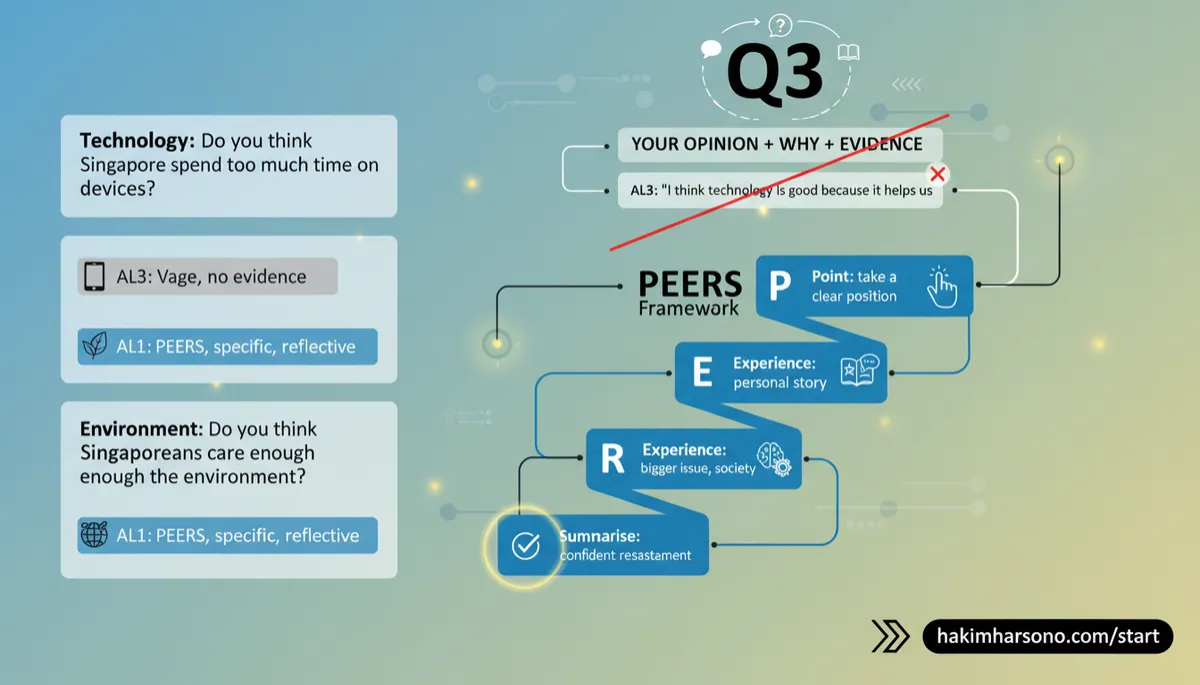
In PSLE oral Q3 opinion questions, examiners are not just asking, “What do you think?” They want three things:
- Your opinion – a clear “yes”, “no”, or specific position.
- Why – a reason that actually explains your opinion.
- Evidence – an example, experience, or observation that proves your point.
The difference between an AL3 and AL1 answer is usually not vocabulary. It is how deeply the student thinks, and whether they can support their view with real, believable evidence. That is where the PSLE oral PEERS framework comes in.
Why “I Think Technology Is Good Because It Helps Us” Is AL3
Many P6 students answer like this: “I think technology is good because it helps us.” On the surface, it sounds fine. But for PSLE oral Q3 opinion questions, this is only an AL3 response. Why?
- No depth of position: “Technology is good” is too broad. Good in what way? For learning? For family time? For health?
- Weak reason: “Because it helps us” repeats the question. It does not explain how or why it helps.
- No evidence: There is no personal story, no example from school, and no observation about Singapore.
An AL1 answer sounds more like a short, thoughtful mini-essay: clear position, strong reason, real experience, and reflection about the bigger picture. That is exactly what the PEERS PSLE oral framework trains students to do.
The PEERS Framework for PSLE Oral Q3 Opinion Questions
Here is how to use the PSLE oral PEERS framework Q3 step by step. Think of it as a simple script your child can follow under exam pressure.
P – Point (Take a Clear, Specific Position)
Start with one sentence that answers the question directly. Avoid “it depends” unless you can handle it well. Be specific: “Yes, I think Singapore students spend too much time on devices.” or “No, I do not think Singaporeans care enough about the environment.”
E – Explain (Give a Substantive Reason)
Next, explain why. This must be more than “because it is good” or “because it is bad”. For example: “When they spend many hours online, they have less time to sleep or exercise, which affects their health and concentration.”
E – Experience (Share One Real Personal Story)
Now add evidence from your life. One short, specific story is enough: “Last year, I used my tablet for games every night and I often felt tired in class the next day.” This makes your answer believable and memorable.
R – Reflect (Zoom Out to the Bigger Issue)
This is where AL1 marks are usually won. Ask yourself: “What does my experience show about Singapore society, human nature or progress?” For example: “This shows that while technology is useful, many students, including me, struggle to control our screen time.”
S – Summarise (End with One Confident Sentence)
Finish by restating your position clearly: “So overall, I do think Singapore students are spending too much time on devices.” This tells the examiner you are organised and confident.
AL3 vs AL1 Example 1: Technology Question
Question: “Do you think Singapore students spend too much time on devices?”
AL3 answer (vague, no evidence):
“I think Singapore students spend too much time on devices because they like to play games and watch videos. It is bad for them, so they should use less. Technology is helpful but they must control themselves.”
This answer has an opinion and a simple reason, but no real story, no reflection, and very general statements.
AL1 answer using PEERS:
P: “Yes, I think many Singapore students do spend too much time on devices.”
E: “When we are online for many hours, we sacrifice sleep, exercise and even family time, which can affect our health and relationships.”
E (Experience): “For example, during the June holidays, I often played mobile games until midnight. I felt sleepy the next morning and argued with my parents when they told me to stop. My grades also dropped slightly for my next test.”
R: “This shows that although technology is convenient, many young people in Singapore, including me, have not learnt to manage it responsibly. We enjoy instant entertainment, so we find it hard to set limits without guidance.”
S: “So overall, I do feel that Singapore students are spending too much time on devices and need more self-control.”
AL3 vs AL1 Example 2: Environment Question
Question: “Do you think Singaporeans care enough about the environment?”
AL3 answer (vague, no evidence):
“Yes, I think Singaporeans care about the environment because our country is very clean. There are many dustbins and recycling bins, and people do not litter so much. The government also has many campaigns, so I think they care enough.”
Again, this answer is safe but shallow. It repeats common ideas without a personal angle or deeper thinking.
AL1 answer using PEERS:
P: “I do not think Singaporeans care enough about the environment yet.”
E: “While our streets look clean, many people still rely on cleaners and campaigns instead of taking responsibility themselves.”
E (Experience): “For instance, during a beach clean-up with my school, we collected many plastic bottles and food wrappers. Some were left right next to the bins. My classmates and I were shocked because this was a popular family spot.”
R: “This made me realise that it is easy for us in Singapore to assume someone else will clean up for us. We enjoy a clean and green image, but our behaviour does not always match that image. It shows that convenience is still more important than caring for the environment for many people.”
S: “Therefore, I feel Singaporeans still have a long way to go before we can say we truly care enough about the environment.”
Help Your Child Practise PEERS the Right Way
The PEERS framework turns PSLE oral Q3 opinion questions into a clear, repeatable process. For parents and P6 students, the key is consistent practice with feedback – especially on the Reflect step, where AL1 answers stand out.
If you want more structured PEERS PSLE oral examples, model answers and step-by-step guidance from Hakim Harsono at Speak Easy, visit hakimharsono.com/start to get started today.
