3 Effective Fixes for PSLE Oral Anxiety
PSLE Oral, Parenting, Anxiety Support
My Child Freezes in PSLE Oral: 3 Fixes That Actually Work
By Hakim Harsono, Speak Easy — for Singapore parents of shy or anxious P6 children who dread that moment their child sits down for PSLE oral and goes completely blank.
Why Children Really Freeze in PSLE Oral
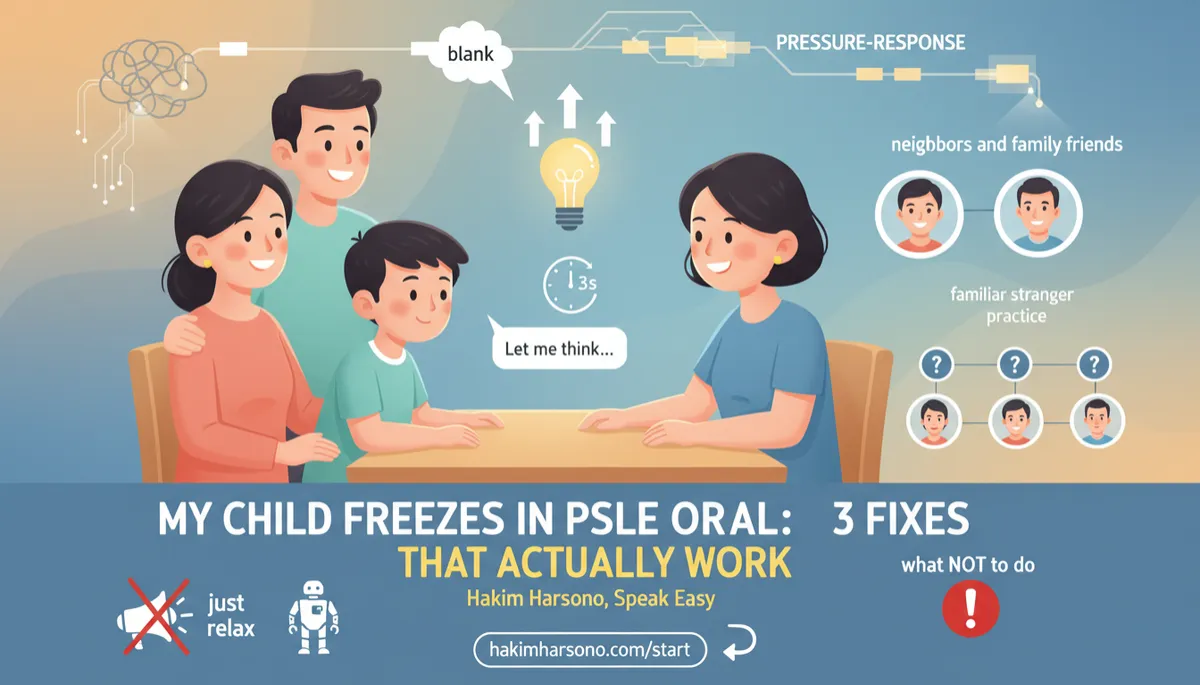
If your child freezes in PSLE oral, you might immediately worry, “Their English is not good enough.” But for most children, especially in Singapore, it is not a language problem and not a knowledge problem. It is a pressure-response problem combined with a structure problem.
Under exam pressure, the brain goes into “threat mode”. Heart rate increases, breathing becomes shallow, and the thinking part of the brain temporarily shuts down. When there is no reliable starting point, your child’s mind does what anxious brains do — it goes blank. That is why a child who chats freely at home can suddenly look like they have forgotten all their English in front of the examiner.
The good news: if child freezes PSLE oral Singapore is your current Google search, you are not alone, and it is highly fixable with the right habits. Let’s walk through three practical fixes you can start using this week to ease PSLE oral anxiety Singapore parents worry about most.
Fix 1: The 3-Second Pause Protocol
Most children answer the moment they hear a question. In an exam, that instant reaction is driven by fear: “I must answer quickly or I’ll look stupid.” This rush triggers panic and freezing. We want to replace that with a calm, automatic response: pause first, then think, then speak.
Teach your child the 3-second pause protocol: they must always wait three full seconds before answering any oral-style question — even at home, even when they know the answer immediately. Three seconds sounds long to your child, but to the examiner it looks like composure and maturity. Those three seconds give the brain a precious beat to calm down and activate a structure like PEEL or PEERS, instead of going into “blank screen” mode.
Daily practice is simple: you ask a mix of easy and harder questions (“What did you eat for recess?”, “How would you improve this school event?”). Your child’s job is not to give a perfect answer. Their job is to always count silently: one… two… three… then speak. After a week, this pause becomes a habit they will naturally carry into the exam room, reducing shy child PSLE oral panic significantly.
Fix 2: The Anchor Sentence
The second reason children freeze is they do not know how to start. Once they get going, many can talk. So we give them a safe “runway”: one default opening line they use before every answer, no matter what the question is. This is the anchor sentence.
Examples of anchor sentences:
“Let me think about that for a moment…”
“That is an interesting question. I believe…”
These are not “fake” stall tactics. They are a structured runway that tells the brain, “We always start like this.” While your child is saying the anchor sentence, their PEEL or PEERS framework is quietly switching on in the background. The brain is no longer scrambling for the first word; it is following a routine it has practised many times at home.
Fix 3: The “Familiar Stranger” Practice
Another big trigger for freezing is the examiner themselves. Speaking to an unknown adult in a formal setting feels threatening, especially for a shy child. We reduce that threat by turning “strangers” into “familiar strangers” before the exam.
Over two weeks, invite three different adults your child does not see every day — a neighbour, a relative’s spouse, a trusted family friend. Ask each of them to sit across from your child and ask just three PSLE oral-style questions. Use the 3-second pause and anchor sentence every time. Keep each session short and positive, with lots of reassurance after.
By the third “familiar stranger”, your child’s brain learns: “Oh, this is just another adult who asks questions. I know what to do.” When PSLE day comes, the examiner feels less like a threat and more like the fourth familiar stranger in the series.
What Not to Do (Even with Good Intentions)
In trying to help, we sometimes make PSLE oral anxiety Singapore children feel even heavier. Avoid these common traps:
- Don’t say “Just relax.” If they could, they would. Instead, give them concrete tools: pause, anchor sentence, familiar strangers.
- Don’t drill memorised answers until they sound robotic. When the actual question changes slightly, memorised scripts collapse and freezing gets worse.
- Don’t over‑frame it as “very important”. They already know PSLE matters. Repeating it raises the stakes in their mind and increases panic.
Help Your Child Start Calm, Not Perfect
Your child does not need to become an extrovert to do well in PSLE oral. They need a calmer body, a predictable starting point, and a few safe experiences with “exam-type” adults. The 3-second pause, the anchor sentence, and familiar stranger practice work together to give exactly that.
If you would like guided support and child-friendly frameworks from Speak Easy, visit hakimharsono.com/start to see how we help shy child PSLE oral performance become calm, clear and confident — one small, practical step at a time.
