Complete PSLE Oral Exam Guide for Parents 2027
PSLE Oral, Singapore Parents, PSLE oral exam guide Singapore, PSLE oral 2027
The Complete PSLE Oral Exam Guide for Singapore Parents 2027
A warm, practical guide by Hakim Harsono – Singapore’s only PSLE Oral Specialist (Speak Easy, A for Oral Masterclass) – to help P5–P6 parents confidently support their children for the 2027 PSLE English Oral Exam.
1. What Is the PSLE Oral Exam And Why It Matters
For many Singapore parents, the PSLE Oral used to feel like a “small paper” that children could simply “wing”. That is no longer true. From 2025 onwards – and continuing into PSLE oral 2027 – the English Oral examination has become a powerful grade booster, or a painful grade breaker, depending on how well your child is prepared.
The PSLE English Oral is Paper 4. It now carries 40 marks, which is a full 20% of the overall English grade. Previously, it was 30 marks (15%). Under the new AL system, that extra 5% can easily be the difference between AL1 and AL2, or between AL3 and AL4 – and that, in turn, can shift your child’s overall PSLE score and school choices. According to recent format summaries, this 40-mark structure is expected to continue for 2027 unless SEAB announces otherwise, so parents of current P5s and P6s should plan with this in mind (psleprep.sg, archeacademy.com.sg).
Another key detail many parents miss: the PSLE Oral exam is usually held in mid to late August, before the written papers. That means your child’s very first PSLE experience is a face-to-face conversation with examiners. Starting strong in Oral helps them enter the written papers with confidence; starting poorly can shake their self-belief just weeks before the main exams (archeacademy.com.sg, projected 2027 timeline based on past patterns).
This is why a clear, structured PSLE oral exam guide Singapore – designed specifically for parents – is so important. You do not need to be an English teacher to help. You just need to understand the format, the expectations, and a few powerful frameworks that your child can rely on under exam pressure. That is exactly what this guide by Hakim Harsono will walk you through, step by step.
2. The 5 Key Changes From 2025 (Still Relevant for 2027)
From 2025, MOE and SEAB introduced a new English Oral format that continues to apply to PSLE oral 2027. Parents whose older children took PSLE before 2025 will notice real differences. Here are the five key changes you must know, explained in parent-friendly terms.
Change 1: 40 Marks, Now 20% of English Grade
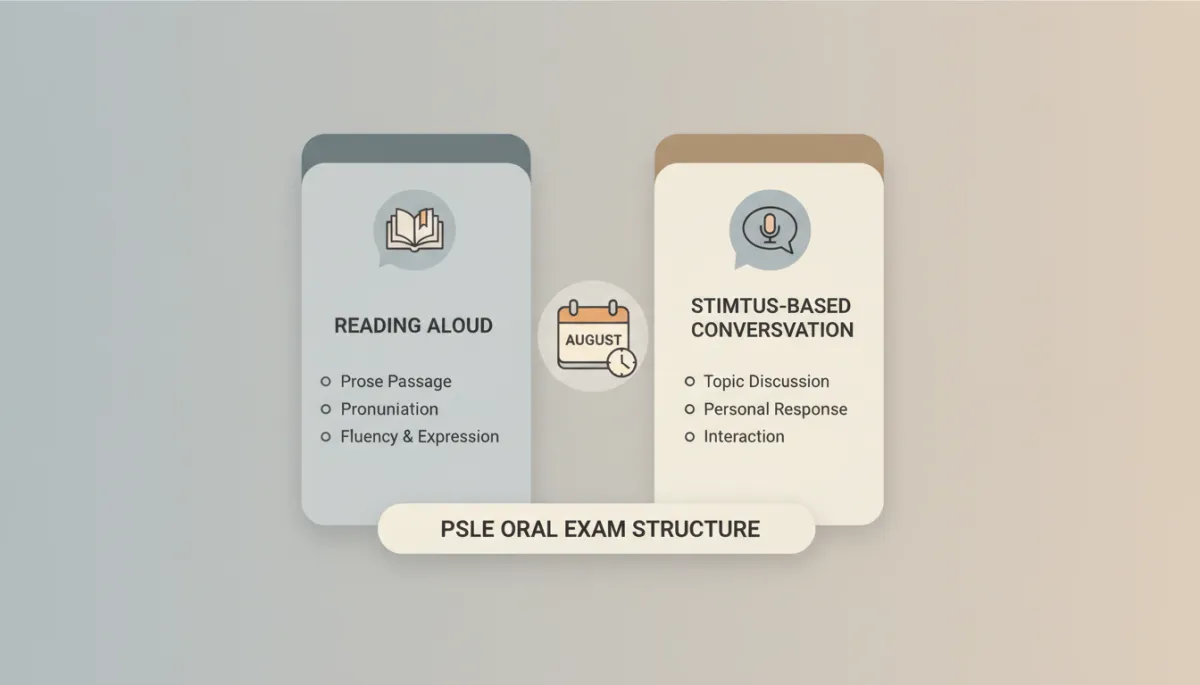
Oral used to be 30 marks (15%). It is now 40 marks (20%): 15 for Reading Aloud, 25 for Stimulus-Based Conversation (SBC). This makes Oral the single highest-weighted component within English. A jump from 23/30 to 34/40 can easily push an AL3 up to an AL2, or an AL2 up to an AL1, especially when combined with strong Paper 1 and 2 performance.
Change 2: Reading Aloud Now Has a “Given Situation” Preamble
In the past, children simply read a passage. Now, they are given a short description explaining who they are reading to, why, and in what context. For example, “You are reading this announcement to your classmates during assembly to invite them to a recycling drive.” This means your child must adjust their tone and expression based on the situation, not just read accurately. This is where the PACT framework (Purpose, Audience, Context, Tone) becomes crucial – we will cover this in detail later.
Change 3: SBC Uses a Real Photograph, Not a Poster
Previously, students discussed a poster with words, headings and bullet points. Now, they are given a real-life photograph with no text. They must infer what is happening from body language, setting and objects in the picture. This rewards observation and inference, not memorised phrases copied from the poster. A structured method like 5W1H (Who, What, Where, When, Why, How) helps children talk about the picture confidently even when it looks “simple”.
Change 4: Three Independent Questions, No Sub-Prompts
In the old format, the examiner used to guide students with sub-questions like “What is happening here?” or “How do you think the boy is feeling?”. Those sub-prompts are gone. Now, there are three main questions:
- Q1 – Picture-based: describe or infer from the photo.
- Q2 – Personal experience related to the theme.
- Q3 – Opinion or broader view on the issue.
Students must structure their answers independently. This is why we use PEEL and PEERS in Speak Easy and A for Oral Masterclass – to give children a repeatable answer “skeleton” they can rely on, even when nervous.
Change 5: Reading and SBC Are No Longer Thematically Linked
In the past, the reading passage and conversation shared a common theme (for example, both about “sports”). From 2025 onwards, they are independent. Your child cannot depend on the reading passage to “prepare” ideas for the conversation. Instead, they need a broad bank of personal stories and opinions across common themes – something we will show you how to build at home in this guide and in our article on past topics at /psle-oral-topics-past-year/.
Before / After Comparison Table (Pre-2025 vs 2025–2027)
| Feature | Before 2025 | 2025–2027 Format |
|---|---|---|
| Total marks & weighting | 30 marks (15% of English) | 40 marks (20% of English) |
| Reading Aloud context | Passage only, no given situation | Passage + “given situation” preamble (Purpose, Audience, Context, Tone) |
| SBC stimulus type | Poster with text and headings | Real-life photograph, no text |
| Question structure | Main questions with guiding sub-prompts | 3 independent open-ended questions, no sub-prompts |
| Link between Reading & SBC | Usually same theme | Independent themes, no guaranteed link |
3. The Two Components Explained – With PACT, 5W1H, PEEL and PEERS
Reading Aloud (15 marks): Using the PACT Framework
Reading Aloud is no longer just about “no mispronunciation”. Examiners listen for fluency, pacing, expression and tone that match the situation. To help children decode the “given situation” quickly, Hakim teaches the PACT framework in his classes and in his How to Score AL1 for PSLE Oral guide:
- P – Purpose: Why are you reading this? To inform, persuade, invite, warn, or entertain?
- A – Audience: Who are you speaking to? Friends, teachers, younger pupils, parents, the public?
- C – Context: Where and when is this happening? Assembly, classroom, radio show, community event?
- T – Tone: Given P, A and C, should your voice sound excited, serious, caring, encouraging, or formal?
At home, you can practise by giving your child the same passage but changing the PACT. For example, read the text as if:
- They are inviting classmates to a fun fair (friendly, enthusiastic tone), then
- They are reminding neighbours about dengue prevention (firm, serious but caring tone).
This builds flexibility so that when the real “given situation” appears in the 2027 exam, your child instinctively adjusts their voice instead of reading in a flat, memorised way – something examiners have warned against in both English and Mother Tongue orals (psleprep.sg).
Stimulus-Based Conversation (25 marks): 5W1H, PEEL and PEERS
SBC is where most marks – and most anxiety – lie. The good news is that with clear frameworks, even shy or average students can become confident, coherent speakers. In our PSLE oral format classes, we break SBC into three question types, each with its own tool.
Q1: Picture Inference – 5W1H
For the first question, students describe and infer from the photograph. Instead of giving a scattered answer, we teach them to organise their thoughts using 5W1H:
- Who is in the picture? (Children, parents, staff, volunteers)
- What are they doing? (Activities, main action)
- Where are they? (School hall, park, HDB void deck)
- When might this be? (Weekend, during school hours, evening)
- Why do you think this event is happening? (E.g. community bonding, fundraising)
- How are the people feeling? (Happy, tired, excited, proud – based on facial expressions and body language)
Even weaker students can remember “5W1H” and use it as a checklist. Stronger students can add inferences and short reasons for each point, which pushes them towards AL1-level depth.
Q2: Personal Experience – PEEL
The second question usually asks about your child’s own experience related to the theme. For example, “Have you ever helped out at a community event?” We use the PEEL framework:
- P – Point: Give a clear answer. (“Yes, I helped at a community clean-up organised by my school last year.”)
- E – Example: Share one specific story, not a list. Time, place, people, what happened.
- E – Elaborate: Add feelings, thoughts, and a little detail. What was challenging? What was meaningful?
- L – Link: Tie back to the question or theme. (“This experience showed me that even small actions can make our neighbourhood cleaner and more pleasant for everyone.”)
When parents hear “PEEL PEERS PACT PSLE oral”, it can sound technical. In reality, these are child-friendly checklists that prevent common problems like one-word answers, going off-topic, or giving very general stories with no detail.
Q3: Opinion / Reflection – PEERS
The third question usually asks for an opinion or a broader view. For example, “Do you think it is important for young people to contribute to their community?” Here, Hakim trains students to use PEERS:
- P – Point: State your opinion clearly. (“Yes, I think it is very important.”)
- E – Explain: Give one or two reasons. (“It helps them become more responsible and understand the needs of others.”)
- E – Experience: Link to a short experience or example (their own or someone they know).
- R – Reflect: Share a thoughtful insight. (“If we start helping when we are young, it becomes a habit and we will continue contributing as adults.”)
- S – Summarise: Wrap up in one short sentence. (“So, contributing to the community is important because it shapes our character and benefits everyone.”)
That Reflect step is where many AL1 answers are “won”. We will look at this in more detail in the next section on AL1 vs AL2 vs AL3.
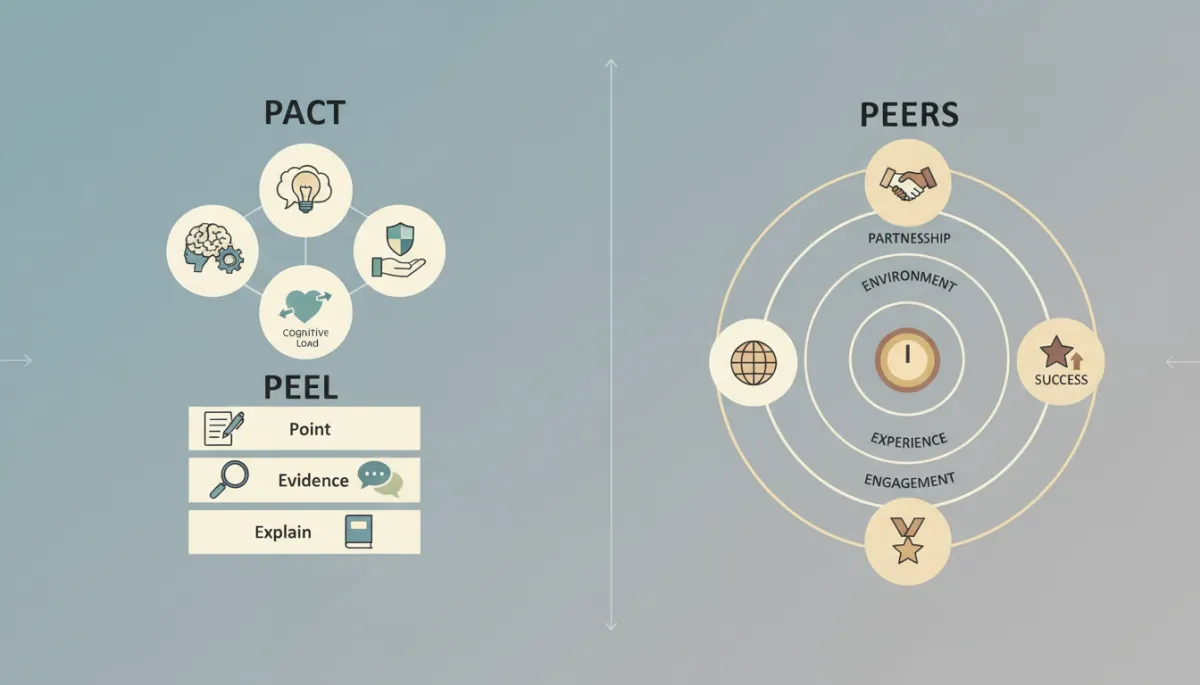
Simple frameworks like PACT, PEEL and PEERS give children calm, repeatable structures under exam pressure.
4. AL1 vs AL2 vs AL3 – Content Depth and Personal Specificity
Many parents assume that AL1 students use “chim” vocabulary while AL2 or AL3 students use simpler words. In reality, examiners have repeatedly emphasised that the main difference is content depth, clarity and personal specificity, not bombastic phrases. An answer with simple words but rich reflection can score higher than an answer stuffed with memorised idioms that do not fit naturally (psleprep.sg, schoolbag.edu.sg).
Let’s look at a concrete example on the theme of community. Imagine the examiner asks: “Have you ever done anything to help your community? Tell me about it.”
Typical AL3-Level Response
“Yes, I have. I joined a community clean-up before. We picked up litter around the neighbourhood. It was quite tiring but I felt happy because we made the place cleaner. I think helping the community is important.”
- Strengths: On-topic, clear, some feelings mentioned.
- Limitations: Very general, no specific details (when, where, who), shallow reflection.
Improved AL2-Level Response (Using PEEL)
“Yes, I have helped my community during a clean-up activity organised by my Residents’ Committee last June. My parents and I joined our neighbours to pick up litter around the playground and void deck near our block. At first, I felt a bit embarrassed because we had to carry tongs and trash bags, but after a while I realised that many people were smiling and thanking us. When I saw how much rubbish we collected, I felt proud that we had made our neighbourhood cleaner. This experience showed me that if everyone does a little bit, our community can become a more pleasant place to live in.”
- Strengths: Specific time and place, clear sequence, feelings before and after, simple but meaningful link.
AL1-Level Response (PEEL + Reflective Extension)
“Yes, I have. Last June, my Residents’ Committee organised a Sunday morning clean-up around the playground and void deck near my block, and my parents encouraged me to join. At first, I felt slightly reluctant because it meant waking up early on a weekend and walking around with tongs and rubbish bags. However, as we moved from block to block, I noticed that many neighbours smiled at us and some even thanked us for our effort. When I saw the huge pile of filled trash bags at the end, I felt a strong sense of satisfaction because I realised how much litter we had removed. This experience made me more aware of how my small actions can affect my neighbours’ daily lives. Now, when I see someone littering, I feel more confident to remind my friends nicely, and I also make it a point to throw my own rubbish properly. So, helping my community did not just make the place cleaner for one day – it changed the way I behave in my neighbourhood.”
- Notice the reflective extension: the student links the one event to a lasting change in attitude and behaviour. This is what examiners look for in AL1 – not fancy idioms, but thoughtful, personal insight.
In our specialised PSLE oral tuition Singapore programmes, Hakim spends a lot of time coaching students to move from the AL3 “skeleton” to AL2-level detail, then finally to AL1-level reflection. Parents can support this at home simply by asking follow-up questions after your child shares a story: “How did that change you?” or “What did you learn from that?”.
5. Preparation Timeline for P5–P6 (2027 Cohort)
Because Oral happens in August, preparation cannot be left to “after SA1” or “closer to prelims”. Here is a realistic, parent-friendly timeline for the 2027 PSLE cohort, based on how Hakim structures his Speak Easy and A for Oral Masterclass programmes.
P5 Year – 12+ Months Before PSLE
At P5, the goal is not to “drill exam questions” but to build foundations:
- Strengthen reading fluency and confidence; practise PACT lightly using school passages or storybooks.
- Introduce 5W1H for pictures and get your child used to talking for 1–2 minutes without stopping.
- Start collecting personal stories for common themes like school, family, friends, community, technology, health and environment.
P6 Term 1 – 10 to 14 Weeks
In Term 1, most schools begin formal Oral preparation. This is the ideal time to:
- Systematically teach and practise PEEL and PEERS so they become automatic.
- Do short weekly mock SBCs at home, focusing on one framework at a time (e.g. this week, we focus only on using PEEL properly).
- Identify gaps early – is your child struggling more with content ideas, language accuracy, or nervousness?
June Holidays – 8 Weeks
The June holidays are a golden window. With no school homework, your child can make a huge leap in Oral if practice is consistent and focused rather than last-minute and random. Many parents choose this period to join our intensive programmes or to schedule weekly online sessions. Key goals:
- Build a solid “example bank” of at least 5–8 strong personal stories, rehearsed using PEEL and PEERS.
- Practise different themes using real photographs (you can find ideas in our resource on PSLE oral topics past year).
- Refine Reading Aloud – work on pacing, pausing at punctuation, and varying tone according to PACT.
July – 4-Week Crash Course Phase
By July, Oral is roughly one month away. This is when we shift from learning to performance mode:
- Simulate full Oral exams weekly: Reading Aloud + SBC under timed conditions.
- Fine-tune weaknesses: maybe your child needs to slow down, or to stop repeating the same example for every theme.
- Reinforce exam-day routines: breathing, posture, eye contact, greeting examiners confidently.
August – Days Before the Exam
Even if you are only starting serious Oral prep in August, it is not too late to make a meaningful difference. In the last 1–2 weeks, Hakim often focuses students on just:
- One main framework (usually PEEL or PEERS) so they do not overthink under pressure.
- Three strong stories they can adapt across different themes (e.g. a school event, a family experience, a community activity).
With targeted coaching, we have seen students jump from borderline AL4/5 in school practice to 27/40 and above in the actual PSLE Oral – enough to stabilise their overall English grade. If you would like a personalised plan based on your child’s current level, you can book a free assessment at hakimharsono.com/start.
6. Home Practice Guide for Parents – Simple, Sustainable Routines
You do not need to run a full “tuition centre” at home. In fact, over-drilling can make children dread Oral. Instead, aim for one focused Oral session a week, 20–30 minutes, with clear structure and gentle, specific feedback. Here is a home practice plan many of our parents use successfully.
Step 1: Weekly Mock Exam Format
Once a week, simulate a mini PSLE Oral:
- Give your child a short passage with a simple “given situation”. Ask them to identify PACT in their own words, then read aloud once.
- Show a photograph (from newspapers, school newsletters, or our curated sets) and ask three questions: picture, personal experience, opinion. Use 5W1H, PEEL and PEERS as needed.
Keep it timed but kind. The aim is to build comfort, not fear.
Step 2: One Strength + One Improvement Rule
After each mock, follow the “one strength, one improvement” rule:
- Start with one genuine strength you noticed. (“I liked how you described your feelings when you helped your neighbour.”)
- Then give one specific improvement. (“Next time, try to give a more detailed example instead of just saying ‘I helped’. Tell me what exactly you did.”)
Children are much more willing to try again when they feel seen for what they did well, not only corrected for their mistakes.
Step 3: “Familiar Stranger” Practice
In the real exam, your child will speak to two examiners they do not know. To reduce anxiety, it helps to practise with “familiar strangers” – adults your child recognises but does not see every day:
- A neighbour, a relative, a family friend, or even another parent from your child’s CCA.
Ask them to spend 10 minutes as a “mock examiner”, using one photograph and one personal-experience question. This gives your child practice in making eye contact, speaking clearly and managing nerves with someone new, in a safe environment.
Step 4: Build a Personal Example Bank of 5 Genuine Stories
One of the most powerful things you can do as a parent is to help your child build a personal example bank. Aim for at least five genuine stories that they know very well and can adapt to different themes. For example:
- A meaningful school event (e.g. camp, sports day, charity drive).
- A family experience (e.g. caring for a grandparent, a family trip, a challenge you overcame together).
- A community experience (e.g. clean-up, festival, neighbourhood event).
- A personal challenge (e.g. learning a new sport, recovering from an injury, managing time during exams).
- A story related to technology or environment (e.g. limiting screen time, starting a recycling habit at home).
For each story, help your child write a short PEEL outline in a notebook. During Oral practice, ask them to tell one of these stories out loud. Over time, they will be able to recall and adapt them quickly when the exam question appears – without sounding memorised, because the stories are truly theirs.
7. Book a Free Assessment – Help Your Child Aim for 27/30+ and Beyond
Every child is different. Some speak confidently but lack structure. Others have strong ideas but struggle to express them clearly. Some are simply very anxious when facing unfamiliar adults. The fastest way to know what your child truly needs for the PSLE oral 2027 is to get an expert to listen and diagnose – gently, but accurately.
As Singapore’s only dedicated PSLE Oral Specialist, Hakim Harsono has helped hundreds of students through his Speak Easy and A for Oral Masterclass programmes. Over 90% of his students score 27/30 or higher for school oral exams, and many go on to achieve AL1 or AL2 for PSLE English, even if they started out shy or average in P5.
To support busy parents, Hakim offers a free 15-minute, no-obligation assessment. During this short session:
- Your child will do a brief Reading Aloud and SBC attempt using real exam-style materials.
- Hakim will identify 2–3 key strengths and 2–3 priority areas to work on, based on the latest PSLE oral format and marking criteria.
- You will receive a simple, practical action plan – whether or not you choose to enrol in any programme.
If you are serious about helping your child aim for AL1 or AL2, and you would like expert guidance tailored to your child’s personality and current level, you can book your free assessment now at hakimharsono.com/start. Slots are limited each term to ensure quality and individual attention.
With the right understanding of PACT, 5W1H, PEEL and PEERS – and a calm, structured home environment – your child does not need to be naturally talkative to do well. They simply need frameworks they trust, stories they truly own, and adults who believe they can grow. Whether you choose to work with Hakim or to continue on your own using this guide and resources such as /how-to-score-al1-psle-oral/, your support as a parent already gives your child a powerful head start for the PSLE Oral exam – and for every future conversation that matters.
